Introduction: Seeing the Invisible Rules of Nature
The natural world is not random. Every organism—from microbes buried in soil to towering forest trees—exists within a complex web of interactions governed by ecological, evolutionary, and systematic principles. These processes determine not only who survives and who doesn’t, but also how life diversifies, adapts, and persists over time.
Scientific syntheses like those published in the Annual Review of Ecology, Evolution, and Systematics aim to unify these ideas. Rather than focusing on a single species or ecosystem, they reveal the underlying rules that govern life on Earth—rules that operate across scales, from genes to global ecosystems.
This article explores how ecology, evolution, and systematics intertwine to shape biodiversity, influence environmental stability, and guide our understanding of life in a rapidly changing world.

🌱 Ecology: The Web That Connects All Life
What Is Ecology?
Ecology is the study of how organisms interact with each other and with their environment. These interactions form networks of energy flow, nutrient cycling, and biological relationships that sustain ecosystems.
At its core, ecology answers questions like:
- Who eats whom?
- How do species compete or cooperate?
- How does the environment influence survival?
The Structure of Ecological Systems
Ecological systems are structured through:
- Food webs (predator-prey relationships)
- Mutualisms (beneficial interactions like pollination)
- Competition (for resources like light, water, nutrients)
These interactions create a dynamic balance, often referred to as ecosystem stability.
Crucially, ecological relationships are not static. They shift in response to:
- Climate variability
- Resource availability
- Species introductions or extinctions
Scale Matters: From Microbes to Biomes
Ecology operates across multiple scales:
🔬 Micro-scale
- Soil microbes regulate nutrient cycles
- Bacteria influence atmospheric chemistry
🌳 Ecosystem scale
- Forests regulate carbon storage
- Grasslands influence fire regimes
🌎 Global scale
- Ocean plankton drive oxygen production
- Vegetation affects climate systems
This multi-scale complexity highlights a key insight:
👉 Small interactions can have massive global consequences
🧬 Evolution: The Engine of Change
Natural Selection and Adaptation
Evolution is the process by which species change over time through mechanisms such as:
- Natural selection
- Genetic drift
- Mutation
- Gene flow
These processes shape traits that improve survival and reproduction.
Evolution in Action
Examples of evolutionary processes include:
- Plants adapting to drought conditions
- Animals evolving resistance to predators
- Microbes developing antibiotic resistance
Evolution is not just a historical process—it is happening right now, continuously shaping life.
Coevolution: The Dance of Species
Many species evolve in response to each other, a process known as coevolution.
Examples:
- Flowers and pollinators evolving together
- Predators and prey locked in evolutionary arms races
- Parasites adapting to host defenses
This leads to highly specialized relationships that define ecosystems.
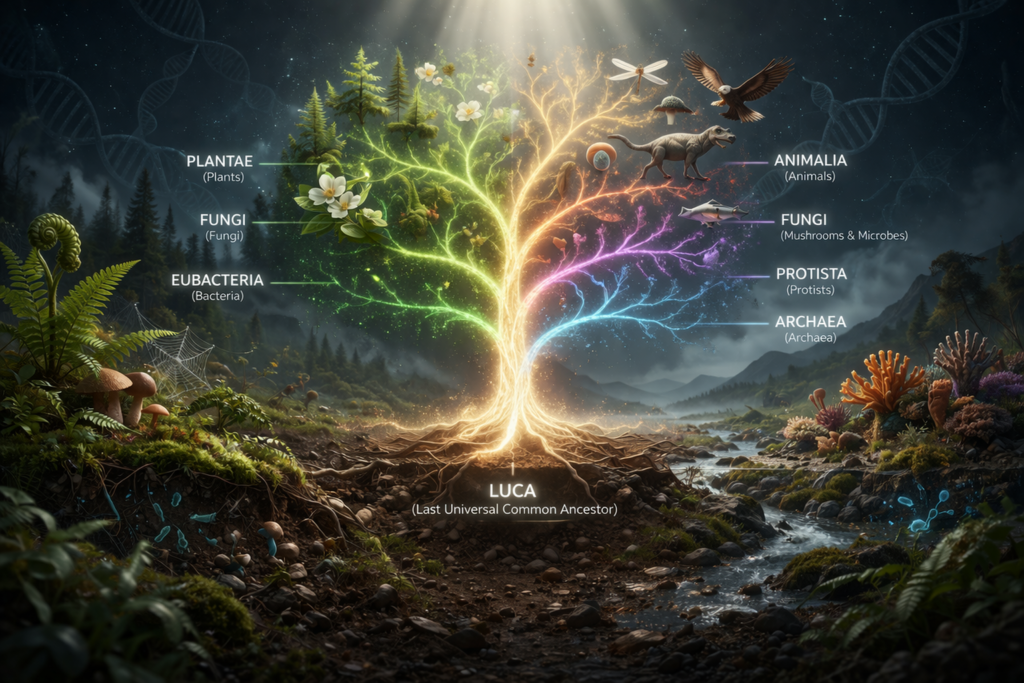
🌿 Systematics: The Tree of Life
What Is Systematics?
Systematics is the science of classifying organisms and understanding their evolutionary relationships.
It helps answer:
- How are species related?
- Where did they come from?
- How has life diversified?
Phylogenetics and the Evolutionary Tree
Modern systematics uses genetic data to build phylogenetic trees, which show how species are connected through common ancestry.
These trees reveal:
- Evolutionary pathways
- Divergence of species
- Origins of biodiversity
Why Systematics Matters
Systematics is essential for:
- Conservation planning
- Understanding biodiversity loss
- Predicting ecological responses to change
Without it, we would lack a framework to understand how life is organized.
🔗 The Integration: Ecology + Evolution + Systematics
A Unified Framework
The key message of research in this field is that ecology, evolution, and systematics are inseparable.
- Ecology shapes evolutionary pressures
- Evolution alters ecological interactions
- Systematics provides the historical context
Together, they form a feedback loop that drives life’s complexity.
Eco-Evolutionary Dynamics
Recent research emphasizes eco-evolutionary feedbacks, where:
- Ecological changes influence evolution
- Evolutionary changes alter ecological systems
Example:
- A predator evolves better hunting skills
- Prey populations decline
- Ecosystem structure shifts
🌍 Biodiversity: The Product of Interconnected Processes
What Drives Biodiversity?
Biodiversity arises from:
- Evolutionary diversification
- Ecological interactions
- Environmental variability
It is not evenly distributed—some regions (like tropical rainforests) are far more diverse than others.
Why Biodiversity Matters
Biodiversity supports:
- Ecosystem stability
- Resource availability
- Climate regulation
Loss of biodiversity weakens ecosystems and reduces resilience.
⚠️ Human Impacts: Disrupting Natural Systems
Habitat Destruction
Human activities are rapidly altering ecosystems through:
- Deforestation
- Urbanization
- Agriculture
This reduces habitat availability and disrupts ecological networks.
Climate Change
Climate change affects:
- Species distributions
- Phenology (timing of life events)
- Ecosystem processes
These changes can lead to mismatches between interacting species.
Invasive Species
Introduced species can:
- Outcompete native species
- Alter ecosystem structure
- Reduce biodiversity
🔬 Modern Tools and Approaches
Genomics and Big Data
Advances in genetics allow scientists to:
- Track evolutionary changes
- Identify species relationships
- Monitor biodiversity
Modeling and Prediction
Ecological models help predict:
- Species responses to climate change
- Ecosystem shifts
- Extinction risks
🌱 Resilience and the Future of Ecosystems
What Is Resilience?
Resilience is the ability of an ecosystem to:
- Resist disturbances
- Recover after disruption
Factors That Promote Resilience
- High biodiversity
- Strong ecological networks
- Functional redundancy
Managing for the Future
Conservation strategies focus on:
- Protecting habitats
- Maintaining biodiversity
- Restoring degraded ecosystems
🌌 Big Picture: The Rules That Govern Life
The central takeaway from this body of research is clear:
👉 Life on Earth is governed by interconnected processes spanning ecology, evolution, and systematics.
These processes:
- Shape biodiversity
- Regulate ecosystems
- Determine how life responds to change
Understanding them is essential for:
- Predicting environmental change
- Conserving biodiversity
- Managing natural resources
🚀 Conclusion: Why This Matters More Than Ever
In a world facing rapid environmental change, understanding the hidden rules of nature is no longer optional—it is essential.
The integration of ecology, evolution, and systematics provides a powerful framework for understanding:
- How ecosystems function
- Why species survive or go extinct
- How life adapts to changing conditions
Ultimately, this knowledge gives us the tools to:
- Protect ecosystems
- Sustain biodiversity
- Ensure a stable future for life on Earth