
The owl arrives without a sound.
One moment the branch is empty, just a dark line against a sky washed in silver. The next, a shape materialises there — broad wings folding inward, feathered ear tufts catching the moonlight, yellow eyes glowing like coals banked under ash.
The forest holds its breath.
Moonlight pours between trunks, painting pale stripes across the leaf litter. The air is cool and smells of damp soil, crushed needles, the faint sweetness of decaying leaves. Somewhere in the distance, a stream talks quietly to itself, water rubbing over stone. The daytime chorus has long since faded — no songbirds, no bees, no human footfalls — yet the night is anything but empty.
If you stand still and really listen, the world after dark begins to bloom.
A chorus of tiny rustles — a mouse testing the edge of a log, a beetle navigating a fallen leaf. The dry, papery calls of distant insects. A fox padding through ferns, its paws as soft as shadows. Overhead, bats flicker in and out of the moonlight like misfired thoughts.
And above it all, watching, is the great horned owl.
Tufts raised.
Body still.
Head turning — slowly, impossibly far — to scan the forest below.
This is the doorway into another planet layered atop our own: the nocturnal world. A world governed by different rules, different senses, different pressures. A world where darkness is not the absence of light, but a habitat in its own right — one that has shaped bodies, behaviours, myths, and ecosystems for millions of years.
Tonight, we follow the owl into that world.
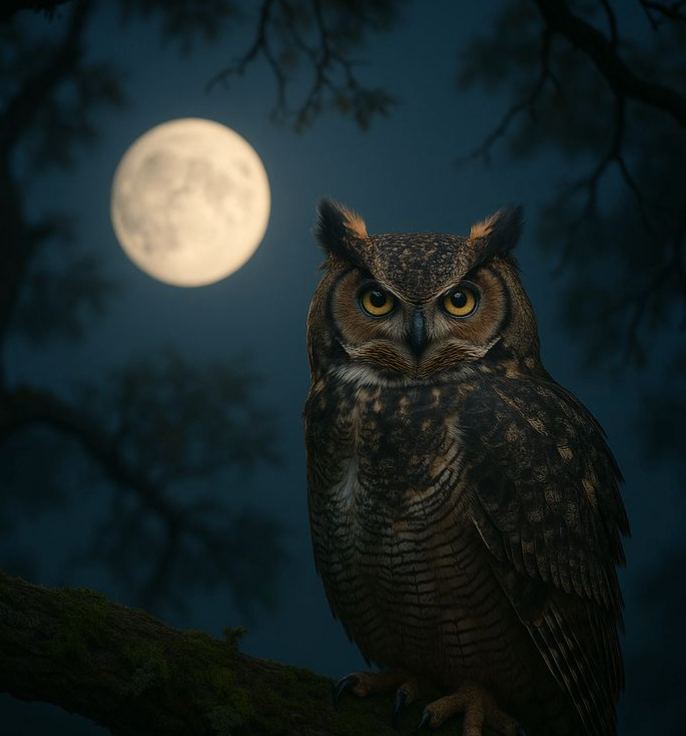
Part I: Meeting the Night Hunter — The Great Horned Owl
The great horned owl (Bubo virginianus) is the archetypal owl for many people — the one we picture on Halloween decorations and storybook covers. Big, broad-winged, with a barrel-shaped body and ear-like tufts, it looks like it could have walked out of a myth rather than a field guide.
In reality, it’s a very practical animal: a supremely adaptable predator found across most of North and parts of South America. It lives in deserts and swamps, suburbs and old-growth forests, city parks and windswept cliffs. If there’s enough prey and some kind of vertical structure — a tree, a rock ledge, even a building — a great horned owl can make a life there.

Its physical design is all about silent power:
- Size: Females (often larger than males) can reach nearly 60 cm tall, with a wingspan over 1.2 meters.
- Camouflage: Mottled browns, greys, and creams break up its outline, turning it into bark or shadow when it stays still.
- Eyes: Huge, forward-facing, with bright yellow irises that stand out in the dark.
- Talons: Crushingly strong — enough to take down prey as large as rabbits or skunks.
It is not the biggest owl in the world, nor the rarest, nor the most specialised. But it is one of the most versatile — a generalist predator that can eat almost anything it can catch: rodents, rabbits, birds, reptiles, even other owls.
In the moonlit forest, though, it is more than a list of traits.
It is presence made feathered.
Perched beneath the full moon, the great horned owl is both animal and symbol — a real living creature and a doorway into deeper questions about how life survives, communicates, and balances itself in the dark.
Part II: Built for Darkness — The Biology and Senses of Owls
Eyes that Drink the Night
Look into an owl’s face and the first thing you notice are the eyes. They’re enormous relative to the skull, forward-facing like ours, giving them binocular vision and excellent depth perception — crucial for judging distance when swooping down on prey.
But there are a few important differences from our eyes:
- Fixed in place: Owl eyes are tubular rather than spherical and are virtually fixed in their sockets. They can’t roll their eyes like we do. Instead, they move their entire head.
- Neck rotation: To compensate, they evolved highly flexible necks — up to around 270 degrees of rotation. Special adaptations in blood vessels help keep the brain supplied while the neck twists.
- Low-light specialists: The retinas are jam-packed with rod cells, which are more sensitive to low light but don’t see colour as well. Owls likely perceive the world in muted tones where brightness and contrast matter more than hue.
- Light amplification: While not all owl species have the classic “eye shine” of a cat, many have structures that help reflect and increase available light.
An owl’s world is not pitch-black. It’s a landscape of gradients — silhouettes, textures, subtle differences in brightness — and their eyes are tuned to read those gradients like a map.
Ears that See in Sound
If their eyes are impressive, their ears are extraordinary.
Owls are sound-hunters. Many species, including great horned owls and especially barn owls and northern saw-whets, can locate prey they cannot see — buried under snow, hidden in grass, moving in total darkness.
Key adaptations:
- Asymmetrical ears: In many owls, the ear openings are offset — one is slightly higher or differently shaped than the other. This creates tiny timing and intensity differences in the sound arriving at each ear, which the brain uses to build a 3D picture of where the sound is coming from.
- Facial disc: The circular “face” many owls have is actually a dish made of stiff feathers that funnel sound toward the ears, like a built-in satellite dish.
- Feathered ear tufts: Those iconic “horns” on a great horned owl are not ears at all. They’re feather tufts likely used in communication and camouflage — breaking up the outline of the head.
Imagine hearing not just the fact that there is a mouse, but precisely where it is, how fast it’s moving, and even its size — all from faint scurrying beneath leaves. That is an owl’s superpower.
Feathers for Silence
If the owl is a hunter of sound, stealth is everything. Prey that hears the predator approaching has a chance to flee. So owls have turned their entire bodies into quiet machines.
Their feathers are:
- Soft-edged: The leading edge of the wing feathers is serrated, breaking up turbulence into smaller, quieter currents.
- Velvety: The upper surfaces are covered in fine down that dampens sound.
- Flexible: The overall structure of the wing is designed to trade some speed for silence.
The result is an almost eerie quiet. Many people standing directly under a low-flying owl describe feeling the wind before ever hearing anything.
In a world where every rustle could mean a meal or danger, silent flight is evolution’s answer to a simple question: how do you sneak through a forest of ears?
Talons, Beaks, and the Digestive Aftermath
Great horned owls are armed and efficient:
- Talons clamp down on prey with tremendous force. In many cases, the grip alone is enough to kill.
- Beaks are hooked for tearing flesh into swallowable pieces.
- Digestive systems are geared toward efficiency: soft tissues are digested, while bones, fur, and feathers are compacted into pellets and later regurgitated.
Those pellets, often found under favourite roosts, are biological records — revealing what the owl has been eating and, by extension, which prey species are abundant.
Every part of the owl’s body tells a story of life lived in darkness — of pressures shaped by hunger, competition, and the physics of moving silently through space.
Part III: Not Alone in the Dark — Other Nocturnal Predators
Owls share the night with a whole cast of specialised hunters.
Mammals of the Moonlight
- Foxes and coyotes trot along forest edges and open fields, using keen hearing and smell to locate rodents, insects, and carrion.
- Wild cats (like bobcats and lynx) stalk in the shadows, relying on binocular vision and padded paws to approach quietly.
- Small carnivores such as martens, weasels, raccoons, and genets climb and clamber through trees and understory in search of eggs, nestlings, small mammals, and invertebrates.
Their strategies overlap with the owl’s: be quiet, be patient, be precise.
Aerial Night Hunters: Bats
While owls hunt mostly by sight and sound combined, bats add something else entirely: echolocation. They emit high-frequency calls and interpret the returning echoes to form an acoustic image of their surroundings.
Where owls dominate the world of small vertebrates at night, bats rule the insect skies — consuming vast numbers of moths, beetles, and mosquitoes, helping keep insect populations in check and pollinating plants in the process.
Silent Snakes and Ambush Spiders
In many forests, nocturnal snakes use heat-sensing pits and smell to locate small mammals and birds roosting at night, ambushing them from branches or ground cover. Spiders weave webs in insect-rich flight paths, capitalising on traffic that continues long after dark.
Night is not empty. It is simply crowded with specialists whose senses are tuned to subtler cues.
Part IV: Night Ecology — Food Webs, Communication, and Evolution in the Dark
The Nighttime Food Web
Even when you cannot see it, energy moves through the ecosystem in complex loops:
- Plants capture sunlight during the day, storing energy in leaves, seeds, and roots.
- Herbivores (like voles and rabbits) feed mostly at dawn, dusk, or night to avoid daytime predators.
- Nocturnal predators — owls, foxes, cats, snakes — harvest this herbivore energy under the cover of darkness.
- Scavengers and decomposers recycle the remains, returning nutrients to the soil.
Remove a predator like the owl, and rodent populations can spike. Too many rodents may overgraze plant seedlings or spread disease. The whole structure wobbles.
This idea — that predators help regulate ecosystems from the top down — is central to modern ecology. It’s not just about “protecting cute animals”; it’s about maintaining the processes that keep forests, fields, and wetlands functioning.
Communication in the Dark
If you can’t rely on colour or visual displays, how do you communicate?
Nocturnal creatures have evolved a range of strategies:
- Sound:
- Owls hoot, screech, or trill to defend territories and attract mates.
- Frogs call from ponds, each species with its own rhythm and pitch.
- Insects chirp, click, or buzz, advertising themselves to mates or rivals.
- Smell:
- Mammals mark territories with scent glands or urine.
- Some species recognise individuals by scent alone.
- Touch:
- Bats jostle and groom each other in roosts, reinforcing social bonds.
- Rodents use whiskers to explore and communicate subtle cues.
- Light:
- Fireflies use bioluminescence to signal potential mates in complex visual codes.
The nighttime landscape can sound chaotic to human ears — a jumble of hoots, chirps, rustles, and croaks. But within that soundscape, information is structured and precise, carrying the messages that allow animals to find food, avoid danger, and reproduce.
Why Evolve Nocturnality?
Becoming active at night is one possible solution to several evolutionary challenges:
- Avoiding heat: In hot climates, being active at night reduces the risk of overheating.
- Avoiding competition: If many species forage during the day, shifting to night opens up new niches with less competition.
- Avoiding predators: Prey species might avoid diurnal predators by shifting their schedules — though this invites a different set of nocturnal predators.
- Tracking prey: If your preferred prey is most active at dawn and dusk or night, it pays to match their timetable.
Over millions of years, these pressures sculpted bodies and behaviours — lengthening some senses, shrinking others, reshaping eyes, ears, and brains.
In other words, nocturnality isn’t an afterthought. It’s a coherent strategy, honed over deep time.
Part V: Darkness as Habitat — The Science of Night
We often think of darkness as simply “not light,” an absence rather than a presence. For nocturnal life, that’s far from true.
Light Levels, Moon Cycles, and Behaviour
The brightness of night varies dramatically depending on:
- moon phase
- cloud cover
- snow on the ground
- tree canopy
Some predators and prey time their behaviour to these changes. On bright, full-moon nights:
- Rodents may reduce activity to avoid being seen.
- Some predators hunt less, conserving energy when prey is scarce.
- Others, like some owl species, may hunt more if their vision benefits from the extra light.
The moon, reflected in an owl’s eye, is not just beautiful. It is an environmental variable.
Biological Clocks and Hormones
Most animals, including humans, run on circadian rhythms — internal clocks tuned to roughly 24-hour cycles of light and darkness. Hormones like melatonin rise and fall with these cycles, influencing:
- sleep
- metabolism
- immune function
- reproduction
- migration
For nocturnal animals, the dark period is their “day.” Their physiology is set to peak when the sun disappears. Artificial light at night can disrupt these cycles, with consequences that ripple through populations.
Navigating the Night
Many animals use natural cues to orient and navigate:
- Stars and the Milky Way
- The position of the moon
- The Earth’s magnetic field
- Polarised light patterns at dusk and dawn
These cues can be disrupted by city glow, changing cloud patterns, or electromagnetic pollution, with impacts on migratory birds, insects, and even sea turtle hatchlings.
Darkness is not empty. It’s a textured, information-rich environment that animals read with astonishing precision.
Part VI: Owls in Myth, Magic, and Culture
Owls have been watching humans watch them for a long time — and we’ve loaded them with meaning.
Symbols of Wisdom and War
In ancient Greece, the owl was sacred to Athena, goddess of wisdom and strategy. It appeared on coins. It watched over the Acropolis. To see an owl flying over a battle was considered a good omen.
From this legacy, the idea of the “wise old owl” seeped into Western stories and children’s books.
Messengers Between Worlds
In many cultures, owls are linked to the spirit world:
- In some Indigenous North American traditions, certain owls are seen as messengers or omens, sometimes associated with death, sometimes with protection or transformation.
- In parts of Africa and Europe, they have historically been feared as witches’ familiars or harbingers of misfortune.
- In Japan, certain owl species are considered lucky; the word for owl (fukurō) can be written with characters meaning “no hardship.”
These beliefs are complex and varied — sometimes reverent, sometimes wary. They reflect a deeper truth: owls feel “otherworldly” to us. Their silent flight, huge eyes, and nocturnal habits blur the line between the seen and unseen.
Modern Stories, Old Archetypes
Contemporary media often turns owls into guides — characters who offer insight, carry letters, or hold secrets. Whether as wise professors in fantasy tales or mysterious background figures, they keep their role as liminal beings.
The owl under the full moon taps into something deep: our sense that night itself is a threshold.
Part VII: Threats to Night-Dwelling Wildlife
For most of Earth’s history, night followed day in predictable, gentle rhythms. Darkness arrived. Stars appeared. Creatures adjusted accordingly.
In just a few centuries — and especially in the last few decades — humans have changed that dramatically.
Light Pollution: The Sky on Fire
Artificial light at night has become one of the most widespread human alterations of the planet. City glows can be seen from space; rural areas are increasingly sprinkled with yard lights, billboards, road lamps.
For nocturnal wildlife, this can be devastating:
- Disrupted navigation: Migrating birds can become disoriented, circling city lights until exhaustion or collision.
- Altered predator–prey interactions: Some predators gain an advantage under artificial light, while prey have fewer safe dark spaces.
- Insect declines: Many insects are attracted to lights, where they may exhaust themselves or become easy prey — disrupting pollination and food webs.
- Physiological impacts: Constant low-level light can interfere with melatonin production and circadian rhythms in many species.
Even for a great horned owl, a forest edge lit by commercial floodlights is not the same habitat as one lit only by the moon.
Habitat Loss and Fragmentation
No matter how well-adapted you are to darkness, you still need a place to live:
- Mature trees for nesting and roosting
- Undisturbed understory for prey
- Quiet corridors to move through without constant disturbance
Urban sprawl, intensive agriculture, and road networks fragment these habitats. Owls may adapt to city parks and suburbs, but more specialised nocturnal species — certain bats, amphibians, and invertebrates — often cannot.
Pesticides and Rodenticides
Poison used to control rodents doesn’t stop with the target.
When owls, foxes, or bobcats eat poisoned rodents, they can suffer secondary poisoning — internal bleeding, neurological damage, weakened immune systems. You may never see the connection, but each bait box can cast a long, invisible shadow up the food web.
Climate Change
Shifts in temperature and precipitation alter:
- timing of insect hatches
- migration patterns
- snow cover and its insulating properties
- forest composition
Nocturnal predators that rely on specific prey cycles, snow conditions, or habitat types may find life increasingly unpredictable.
The night world, once stable and cyclical, is being pushed off-balance.
Part VIII: What We Can Do — Protecting the Night and Its Creatures
The good news: you don’t need to be a scientist, landowner, or policymaker to make a difference. Small, thoughtful actions add up — especially when many people take them.
1. Rethink Your Lights
- Use only what you need. Turn off outdoor lights when you’re not using them. Consider motion sensors instead of lights that burn all night.
- Shielded fixtures. Choose lights that direct illumination downward instead of spilling it into the sky or neighbouring habitats.
- Warm colours, low intensity. Cooler, blue-white lights are more disruptive to wildlife and human sleep. Warmer, lower-intensity bulbs are better for both.
Bonus: you’ll likely save energy and see more stars.
2. Create (or Preserve) Night-Friendly Habitat
- Leave some wild. If you have a yard or property, allow a section to be less manicured — native shrubs, brush piles, old logs. These support nocturnal insects, small mammals, and the predators that depend on them.
- Protect old trees. Where safe, retain large trees; they can provide nest sites and roosts for owls and bats.
- Install nest boxes designed for owls or small cavity-nesting birds, following local guidelines so they’re safe and effective.
3. Avoid Rodent Poison
- Use snap traps rather than anticoagulant rodenticides.
- Seal buildings, remove attractants like open food, compost, or clutter to prevent infestations in the first place.
- Advocate for rodent control methods that minimise collateral damage to predators and scavengers.
Every poisoned mouse is potentially a poisoned owl.
4. Support Dark Sky and Conservation Initiatives
- Join or support dark sky organisations working to reduce light pollution in your region.
- Speak up locally when new developments propose excessive lighting.
- Support protected areas — parks, reserves, community forests — that provide refuges where night remains truly dark.
5. Learn and Share
- Attend nighttime nature walks, owl prowls, or bat talks in your area.
- Teach children (and curious adults) to appreciate — rather than fear — the night.
- Share what you learn about nocturnal wildlife on social media or in community groups, helping shift cultural attitudes.
When people care, policies and practices can change.
Part IX: Returning to the Owl and the Moon
The forest has settled deeper into night.
The full moon rides high now, tracing silver along every branch and stone. The great horned owl, once perched in stillness, launches from its branch and glides through the dark — a ripple of muscle and feather, a shadow sliding over the forest floor.
It crosses a patch of meadow, low and silent, then rises to another perch. It waits. Listens. The tiniest rustle reaches its ears — a mouse testing the open space near the edge of the grass.
The owl drops.
There is a brief flurry of movement, then stillness again. The owl lifts away with its prize, an ancient transaction completed in seconds — life feeding life, the forest’s energy turning another page.
If you’re lucky enough to witness even a fraction of this, it changes you.
You realise the night is not a blank.
It is a living, breathing web of relationships: owls and mice, bats and moths, frogs and fireflies, predators and prey, trees and stars. It is a realm of senses we barely understand, of adaptations honed in silver light and shadow.
To protect the night — to dim our unnecessary lights, to keep wild places wild, to treat creatures like the great horned owl as neighbours rather than decorations — is to honour a world that has been unfolding for millions of years without us.
And in doing so, we also honour something in ourselves:
Our capacity for awe.
Our ability to listen.
Our willingness to live not above nature, but alongside it.
The owl on the moonlit branch is not just a symbol of wisdom in stories. It is wisdom in feathered form — a teacher in a shared universe, reminding us that darkness, too, is sacred.
If we let it, the night can still speak.
Our task is simple, and difficult:
To be quiet enough to hear it.
And brave enough to protect it.