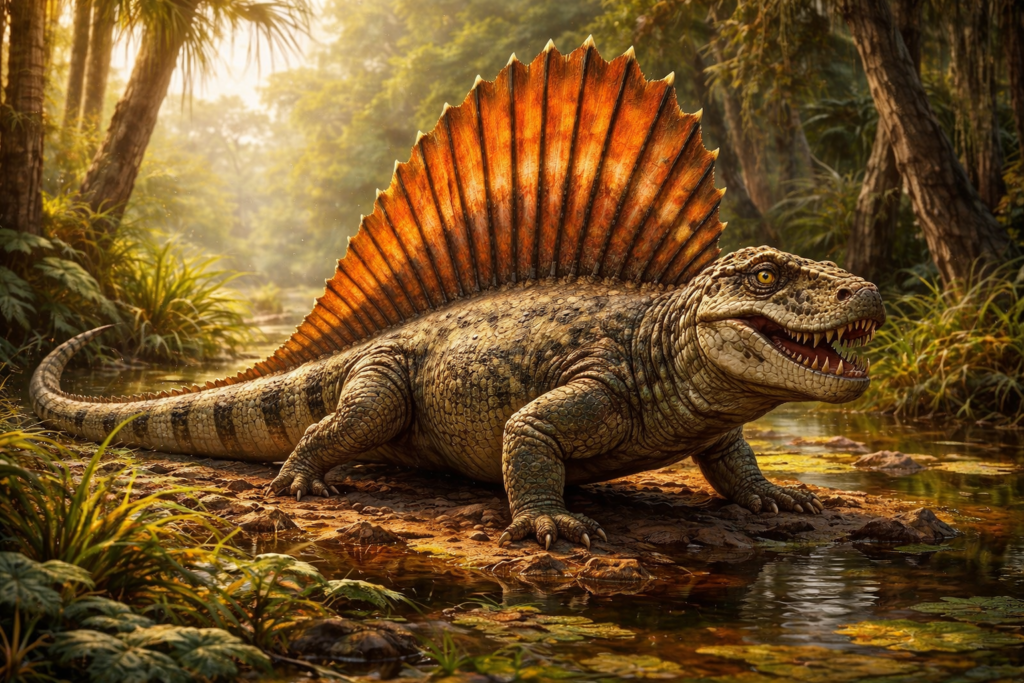
When people imagine prehistoric life, dinosaurs usually dominate the picture—towering predators, massive herbivores, and dramatic extinctions. But dinosaurs arrived relatively late in Earth’s history. Long before them, the land was ruled by a very different kind of animal. These creatures did not roar like tyrannosaurs or soar like pterosaurs. Instead, they walked low to the ground, spread across ancient floodplains, and quietly shaped the first complex terrestrial ecosystems.
These animals were pelycosaurs.
For decades, pelycosaurs were treated as evolutionary side notes—primitive reptiles that existed briefly before being replaced by “more advanced” animals. Modern research has completely overturned that idea. As Stuart S. Sumida explains in Review of the Pelycosauria Revisited (2025), pelycosaurs were not evolutionary dead ends. They were the foundation of modern terrestrial ecosystems, the architects of early food webs, and the first chapter in the long evolutionary story that eventually produced mammals—including us.
Understanding pelycosaurs means rethinking how evolution works, how ecosystems form, and how life adapts to new environments over deep time.
What Exactly Were Pelycosaurs?
Pelycosaurs lived during the late Carboniferous and early Permian periods, roughly 320 to 270 million years ago. This was a world very different from today. Vast swampy forests covered much of the land. The climate fluctuated dramatically between wet and dry phases. Oxygen levels were higher, insects were larger, and vertebrate life on land was still relatively new.
At first glance, pelycosaurs resemble reptiles. They had scaly skin, sprawling limbs, and long tails. But appearances are misleading. Pelycosaurs were not reptiles. They belonged to a group called synapsids, distinguished by a single opening in the skull behind each eye. This skull feature may seem small, but it marks a crucial evolutionary divide.
All mammals are synapsids.
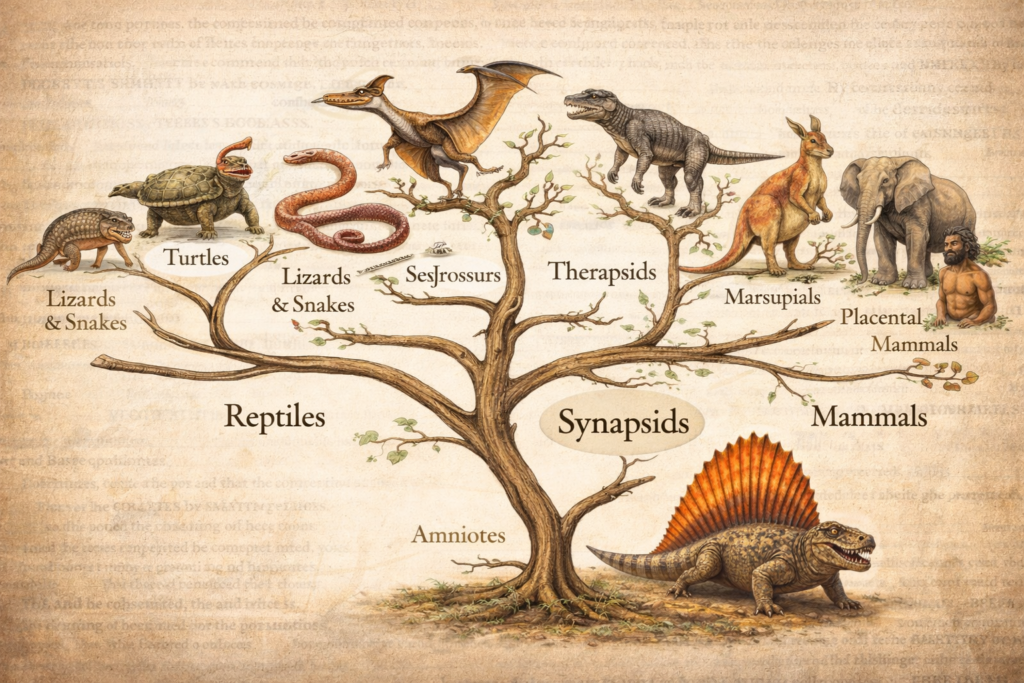
That makes pelycosaurs not distant cousins of mammals, but early members of the mammalian lineage.
This alone makes them important. But their significance goes much deeper.
Pelycosaurs Are Not a Group — They Are a Grade
One of the most important points in Sumida’s review is that pelycosaurs are not a natural evolutionary group, or clade. Instead, they represent a grade—a level of evolutionary organization.
A clade includes all descendants of a common ancestor. A grade includes organisms that share similar traits or levels of complexity, even if they are not all closely related.
Pelycosaurs fall into the latter category.
They represent an early stage in synapsid evolution, before the emergence of therapsids, which later gave rise to mammals. Treating pelycosaurs as a single group hides their diversity and oversimplifies the evolutionary story.
In reality, pelycosaurs included:
- Large apex predators
- Medium-sized carnivores
- Herbivores feeding on early seed plants
- Species adapted to different climates and habitats
They were not waiting to be replaced. They were thriving, diversifying, and dominating terrestrial ecosystems for tens of millions of years.
The Sail-Backed Icons: More Than Just Dimetrodon
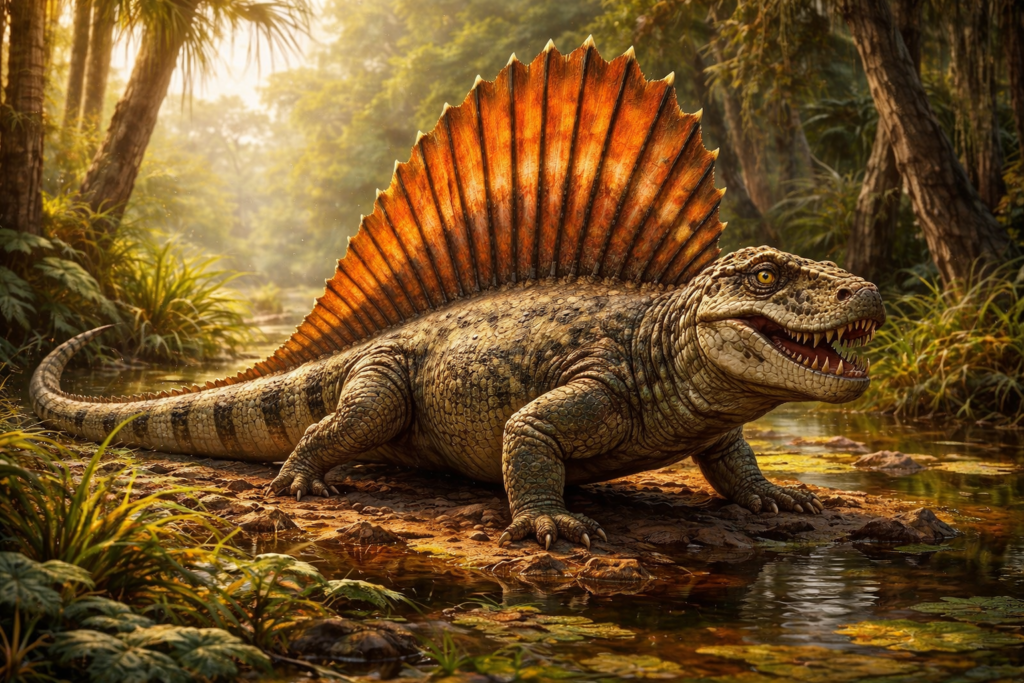
No discussion of pelycosaurs is complete without Dimetrodon, the famous sail-backed predator often mistaken for a dinosaur.
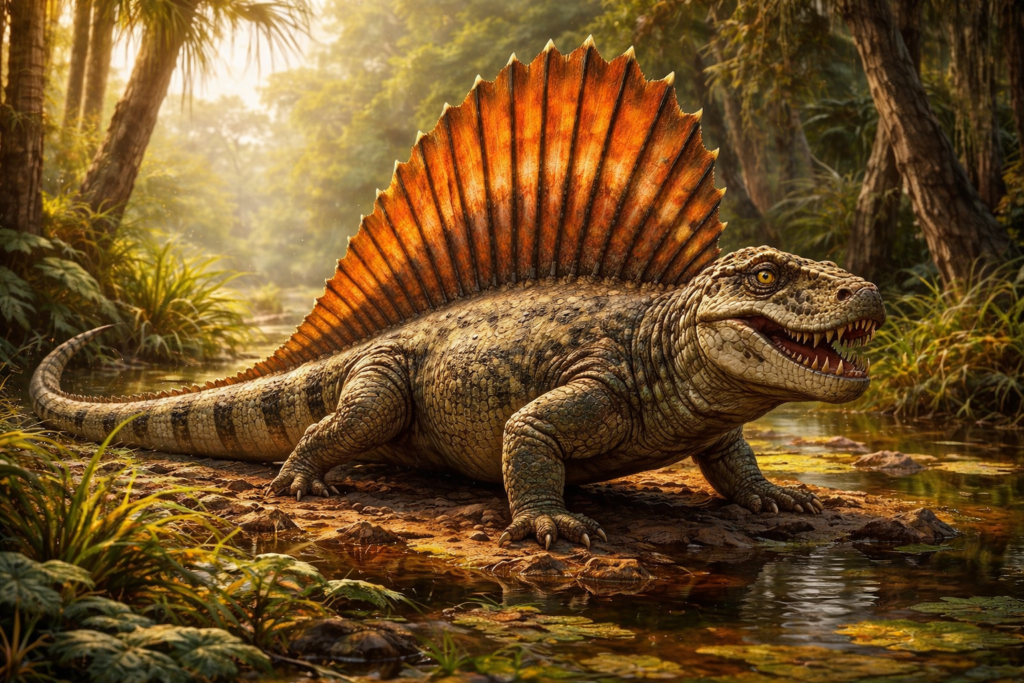
Dimetrodon lived long before dinosaurs existed. Its tall sail, formed by elongated neural spines, has fascinated scientists and the public alike. Early explanations suggested the sail was decorative or used for species recognition. Modern interpretations emphasize thermoregulation.
In the fluctuating Permian climate, managing body temperature would have been crucial. A sail could absorb sunlight in the morning, warming the animal quickly, and release excess heat later in the day. This ability may have allowed Dimetrodon to remain active for longer periods, giving it a major advantage as a predator.
Importantly, this hints at something profound: early experimentation with metabolic strategies that would later become central to mammalian evolution.
Dimetrodon was not sluggish or primitive. It was a highly effective predator, adapted to its environment in sophisticated ways.
The Rise of Complex Food Webs
Before pelycosaurs, terrestrial ecosystems were relatively simple. Early land vertebrates fed mostly on invertebrates or small prey, and food webs lacked clear structure.
Pelycosaurs changed that.
They introduced size-based and role-based ecological hierarchies, including:
- Apex predators controlling prey populations
- Herbivores shaping plant communities
- Intermediate consumers linking trophic levels
This led to energy flowing through ecosystems in more complex ways, increasing stability and resilience.
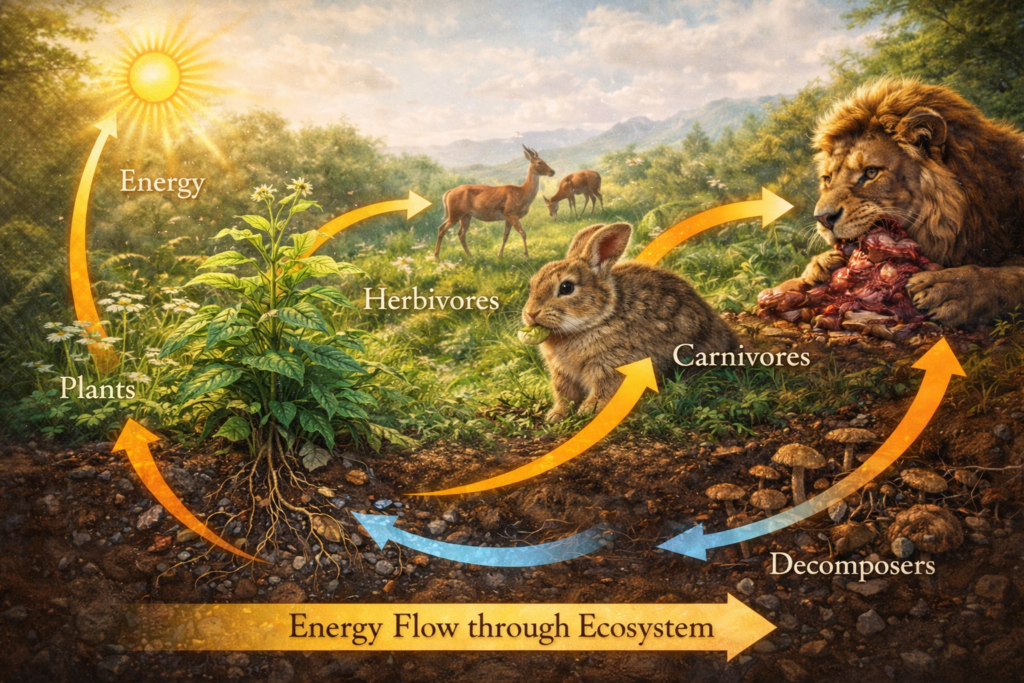
Sumida emphasizes that pelycosaurs were among the first vertebrates to create food webs that resemble modern terrestrial ecosystems. The basic structure—plants at the base, herbivores above them, carnivores at the top—was firmly established during the Permian.
This shift had cascading effects, influencing plant evolution, animal diversity, and ecosystem dynamics.
Early Herbivory and Plant–Animal Interactions
One of the most transformative roles pelycosaurs played was in the rise of vertebrate herbivory.
Feeding on plants is not simple. It requires specialized teeth, digestive strategies, and behaviors. Some pelycosaurs evolved these traits, becoming among the first large animals to rely heavily on terrestrial vegetation.
This had enormous consequences:
- Plants evolved new defenses
- Seed plants diversified
- Landscapes were reshaped by grazing and browsing
These interactions helped drive the co-evolution of plants and animals, laying the groundwork for modern ecosystems.
Amniotes and the Full Colonization of Land
Pelycosaurs were among the early amniotes, animals whose eggs could develop entirely on land. This innovation freed vertebrates from dependence on water for reproduction.

The amniotic egg allowed animals to:
- Spread into drier environments
- Occupy new ecological niches
- Expand across continents
Pelycosaurs took full advantage of this freedom. They explored a wide range of habitats, from swampy lowlands to more arid regions, pushing the boundaries of terrestrial life.
This transition marks one of the most important evolutionary milestones in Earth’s history—and pelycosaurs were right at its center.
Climate, Change, and the Permian World
The Permian was not a stable period. Climate oscillated between wet and dry phases, and ecosystems were constantly reorganizing.
Pelycosaurs thrived in this dynamic world. Their success suggests they were adaptable, capable of adjusting to changing conditions. But even they were not immune to environmental upheaval.
Toward the end of the Permian, ecosystems began to shift dramatically. New synapsid groups emerged, including therapsids, which showed more upright postures, differentiated teeth, and increasingly mammal-like traits.
Pelycosaurs did not disappear overnight. They gradually gave way to these new forms, marking a transition rather than a replacement.
From Pelycosaurs to Mammals
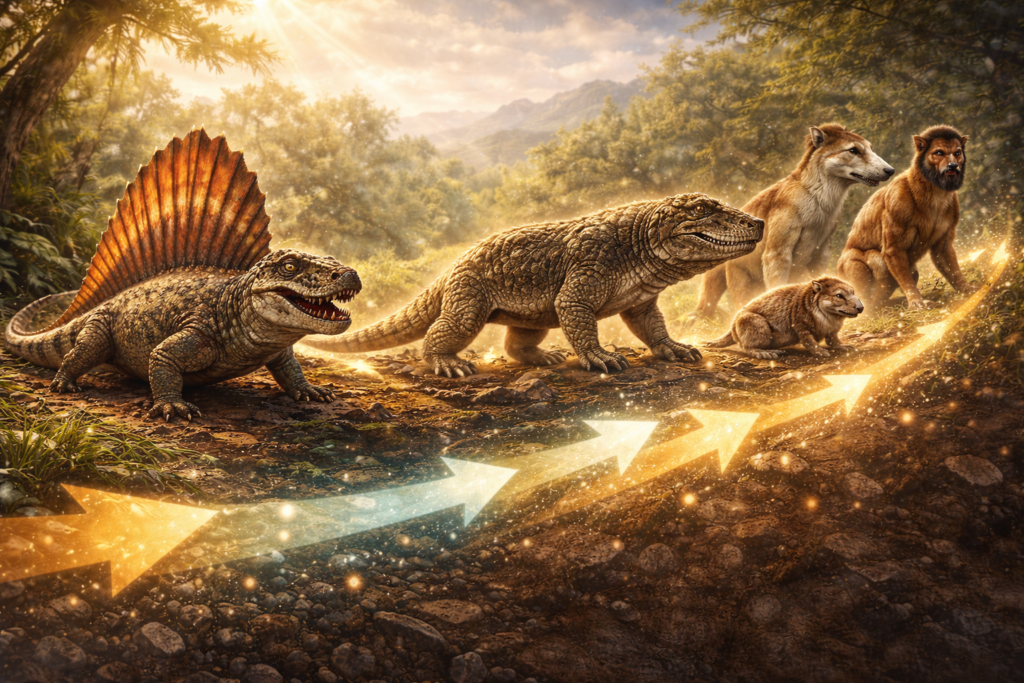
The story of mammals begins long before fur, milk, or warm-bloodedness. It begins with pelycosaurs experimenting with:
- Body size
- Metabolic regulation
- Ecological specialization
These early synapsids set the stage for later innovations. Therapsids inherited and refined many pelycosaur traits, eventually leading to true mammals.
Seen this way, pelycosaurs are not primitive failures. They are successful ancestors, whose evolutionary experiments shaped everything that came after.
Rethinking “Primitive” Life
One of the most important lessons from Sumida’s review is how misleading labels like “primitive” can be.
Pelycosaurs were not inferior versions of later animals. They were well-adapted to their time and place, dominating ecosystems for millions of years. Evolution does not move toward a goal. It responds to conditions.
Pelycosaurs succeeded because they fit their world.
Understanding this helps us better appreciate the complexity of evolution—and the resilience of life.
Why Pelycosaurs Matter Today
Studying pelycosaurs isn’t just about the past. It informs how scientists think about:
- Ecosystem formation
- Evolutionary transitions
- Responses to environmental change
By understanding how early ecosystems formed and stabilized, researchers gain insight into how modern ecosystems might respond to climate shifts and biodiversity loss.
Pelycosaurs remind us that today’s world is built on ancient foundations—and that small changes can lead to profound transformations over time.
The Quiet Architects of the Living World
Pelycosaurs did not leave behind towering monuments or dramatic extinction stories. Their legacy is quieter but deeper.
They shaped the first modern food webs.
They expanded life across land.
They launched the mammalian lineage.
And they did it without fanfare, over millions of years, in a world both familiar and alien.
Long before dinosaurs.
Long before mammals.
Pelycosaurs built the living world we inherited.