For over a century, one branch of the animal family tree seemed almost unquestionable: the Deuterostomia. This group includes familiar organisms such as starfish, sea urchins, acorn worms, and vertebrates—including humans. For generations, biology textbooks treated deuterostomes as a clear evolutionary lineage, defined by shared features of early development.
But modern genomic science has begun to challenge this long-standing assumption. New research summarized in the Annual Review of Ecology, Evolution, and Systematics article “Weighing the Evidence for a Deuterostome Branch of the Animal Tree” explores whether this evolutionary branch actually exists in the way scientists once believed.
This debate may sound highly technical, but it touches on one of the most profound questions in biology: how animals evolved and how the earliest complex organisms diversified hundreds of millions of years ago.
Let’s explore what deuterostomes are, why scientists once believed they formed a distinct evolutionary branch, and why new evidence is reshaping our understanding of animal evolution.

The Big Picture: How the Animal Tree of Life Is Organized
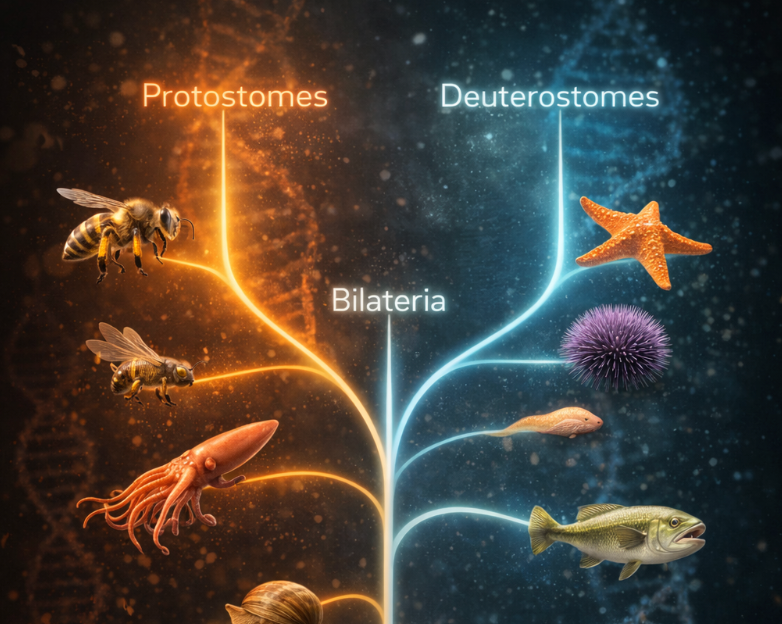
All animals belong to a large evolutionary group called Bilateria, which includes species with bilateral symmetry—meaning their bodies have a left and right side.
Bilaterian animals are traditionally divided into two major evolutionary lineages:
1. Protostomes
This enormous group includes:
- Insects
- Mollusks
- Worms
- Crustaceans
- Many marine invertebrates
2. Deuterostomes
This smaller group includes:
- Echinoderms (starfish, sea urchins)
- Hemichordates (acorn worms)
- Chordates (including fish, birds, mammals, and humans)
For decades, this two-branch system formed the backbone of animal evolutionary biology.
But science is rarely static. As new evidence emerges—especially from genomics and molecular biology—scientists sometimes discover that long-held assumptions need revisiting.
What Makes Deuterostomes Unique?
The term “deuterostome” refers to a particular pattern of early embryonic development.
During early development in animals, an opening forms in the embryo called the blastopore.
- In protostomes, this opening develops into the mouth.
- In deuterostomes, it becomes the anus, while the mouth forms later.
This developmental difference led scientists to believe that deuterostomes represented a deeply distinct evolutionary lineage.
Several other characteristics also supported this idea:
- Similar patterns of early cell division
- Comparable body plan features
- Shared genetic pathways
Together, these traits suggested that echinoderms, hemichordates, and chordates all descended from a common ancestor separate from protostomes.
The Power of Molecular Phylogenetics
For much of the 20th century, evolutionary relationships were reconstructed using:
- anatomy
- embryology
- fossils
But the rise of DNA sequencing and molecular phylogenetics transformed evolutionary biology.
Instead of relying solely on physical traits, scientists could now compare entire genomes across species.
These genetic comparisons sometimes confirmed traditional evolutionary relationships—but sometimes they revealed surprising contradictions.
And in the case of deuterostomes, the genomic data began raising questions.
A Surprising Possibility: Are Deuterostomes Really a Single Branch?
Recent genetic analyses suggest that the deuterostome grouping might not be as clear-cut as previously thought.
Some studies have found that the genetic signal supporting deuterostomes as a single clade is weaker than expected.
Instead, alternative evolutionary trees sometimes appear, suggesting that:
- Chordates (vertebrates and relatives)
- Echinoderms and hemichordates
may not form a single unified lineage.
If true, this would mean that certain features historically used to define deuterostomes might actually have evolved independently or been inherited from even earlier ancestors.
Why This Matters: Understanding Early Animal Evolution
At first glance, the debate over deuterostomes might seem like a technical dispute among evolutionary biologists.
But it actually has enormous implications.
It affects how scientists interpret:
- the origins of complex animals
- the evolution of body plans
- the development of nervous systems
- the emergence of vertebrates
If the deuterostome branch is not a true evolutionary group, it could mean that some traits we once considered unique to this lineage actually evolved much earlier in animal history.
The Cambrian Explosion and Early Animal Diversity
One of the biggest puzzles in evolutionary biology is the Cambrian explosion, which occurred about 540 million years ago.
During this period, many major animal groups appeared relatively quickly in the fossil record.
Understanding the relationships among these groups helps scientists reconstruct what early animals looked like and how they evolved.
Reevaluating deuterostomes could help answer questions such as:
- What did the earliest bilaterian animals look like?
- How many times did complex organs evolve?
- When did major body plans originate?
These questions lie at the heart of evolutionary biology.
The Role of Developmental Biology
Another reason the deuterostome debate is so fascinating is that it connects evolutionary biology with developmental biology.
Developmental genes—often called “toolkit genes”—control how embryos grow and form body structures.
These genes are surprisingly similar across many animal groups.
For example:
- Genes controlling body axis formation
- Genes involved in nervous system development
- Genes regulating segmentation
If deuterostomes are not a natural evolutionary group, scientists may need to rethink how these developmental pathways evolved.
Revisiting Old Assumptions
The challenge to the deuterostome hypothesis highlights an important aspect of science: long-standing ideas can change when new evidence appears.
For over a century, the deuterostome branch seemed secure. But modern genomic data has revealed that evolutionary relationships can be more complex than expected.
Scientists must now weigh different types of evidence:
- embryology
- anatomy
- fossils
- genetic data
The goal is to determine which evolutionary tree best explains all available information.
Competing Hypotheses
Several evolutionary models are currently being debated.
Traditional Model
Deuterostomes form a single evolutionary lineage containing:
- echinoderms
- hemichordates
- chordates
Alternative Models
Some studies suggest that:
- chordates may be more closely related to other groups
- or certain deuterostome traits evolved earlier than expected
These alternative hypotheses challenge the simplicity of the classic two-branch model of bilaterian evolution.
The Importance of Echinoderms and Hemichordates
Two groups of marine animals play a key role in this debate.
Echinoderms
Examples include:
- starfish
- sea urchins
- sea cucumbers
These animals have unusual body symmetry as adults but share developmental features with chordates.
Hemichordates
These worm-like marine animals are less familiar but extremely important evolutionarily.
Their anatomy shows characteristics linking echinoderms and chordates.
Studying these organisms helps scientists reconstruct what the earliest deuterostome-like ancestors might have looked like.
Genomics Is Transforming Evolutionary Biology
One reason this debate is unfolding now is the explosion of genomic data.
Advances in sequencing technology allow scientists to analyze hundreds or thousands of genes across many species simultaneously.
This large-scale genetic information helps researchers build more detailed evolutionary trees.
However, interpreting these data can be difficult.
Different analytical methods sometimes produce different evolutionary relationships.
This means scientists must carefully test alternative models and examine potential biases in genetic analyses.
What This Means for Humans
Humans belong to the phylum Chordata, making us part of the deuterostome lineage under the traditional model.
If the evolutionary relationships among these groups change, it doesn’t alter the fact that humans are vertebrates.
But it could reshape our understanding of how vertebrates evolved and what our distant ancestors looked like.
It might also reveal that some features once thought unique to vertebrates originated much earlier in animal history.
The Future of the Deuterostome Debate
The debate over deuterostomes is far from settled.
Scientists continue to investigate the issue using:
- new genome sequences
- improved phylogenetic models
- fossil evidence
- comparative developmental biology
As more data become available, the evolutionary tree of animals will likely become clearer.
But the process illustrates how science progresses: through continuous questioning, testing, and revision.
Why Scientific Debates Like This Matter
Some people assume that scientific debates indicate uncertainty or weakness in science.
In reality, debates like the one surrounding deuterostomes are a sign of healthy scientific progress.
They show that researchers are actively examining evidence and refining our understanding of the natural world.
Over time, this process leads to more accurate models of biological evolution.
A New Perspective on the Tree of Life
The story of deuterostomes reminds us that the tree of life is not static.
As new technologies reveal deeper genetic patterns, our understanding of evolution continues to evolve.
What once seemed certain may be revised, expanded, or even overturned.
But each discovery brings us closer to answering one of the greatest questions in science:
How did the incredible diversity of animal life on Earth arise?
Final Thoughts
The deuterostome debate illustrates the dynamic nature of evolutionary biology.
For over a century, deuterostomes were considered one of the most stable branches of the animal tree of life. But new genomic evidence suggests that the evolutionary relationships among major animal groups may be more complicated than previously thought.
As scientists continue to explore the genetic and developmental history of animals, they are uncovering a richer and more complex story of life’s origins.
And in doing so, they are reminding us that even the most familiar branches of the evolutionary tree can still hold surprising secrets.