
How microscopic partnerships quietly power ocean ecosystems
The world’s oceans appear vast, open, and dominated by large, visible life — whales, coral reefs, schools of fish, and drifting plankton blooms visible from space. Yet beneath this visible surface lies a hidden engine of biochemical activity that determines how marine ecosystems function, grow, and persist. Central to this engine is the cycling of nitrogen, one of the most essential elements for life in the sea.
Nitrogen is required to build proteins, nucleic acids, and many other biological molecules. Despite being abundant in the atmosphere, nitrogen is often scarce in biologically usable forms within marine environments. As a result, the ocean’s productivity depends on a suite of microbial processes that transform nitrogen between chemical states. Among these processes, ammonia oxidation plays a critical and often underappreciated role.
In their Annual Review article, Thomas and Garritano synthesize emerging research on symbiotic ammonia oxidation — a process in which ammonia-oxidizing microbes live in close association with marine animals and perform nitrogen transformations directly within or alongside their hosts. This work reframes how scientists understand nutrient cycling in the ocean, revealing that nitrogen processing is not confined to free-living microbes drifting in seawater, but is also embedded within complex biological partnerships.
The marine nitrogen cycle: a brief foundation
Nitrogen enters marine ecosystems through several pathways, including nitrogen fixation by specialized microbes, atmospheric deposition, and riverine inputs. Once introduced, nitrogen circulates through living organisms and the environment via a network of biochemical transformations known collectively as the marine nitrogen cycle.
Organic nitrogen is released when organisms excrete waste, die, or decompose. This nitrogen is often converted into ammonia (NH₃ or NH₄⁺), a reduced form of nitrogen that can be toxic at high concentrations but also serves as a crucial intermediate in nutrient cycling. Ammonia does not remain static; it is rapidly transformed by microbes into other nitrogen compounds that influence ecosystem productivity and stability.
Ammonia oxidation is the first step of nitrification, the process by which reduced nitrogen is converted into oxidized forms. In this step, ammonia is transformed into nitrite, which may then be further oxidized into nitrate. These oxidized forms of nitrogen can be taken up by phytoplankton or lost from ecosystems through processes such as denitrification.
For decades, ammonia oxidation was assumed to occur almost exclusively through free-living bacteria and archaea suspended in seawater or residing in sediments. However, recent discoveries have expanded this view dramatically.
From free-living microbes to intimate symbioses
The discovery that ammonia oxidation occurs within symbiotic relationships represents a major conceptual shift in marine biogeochemistry. Researchers have now documented ammonia-oxidizing microbes living within or closely associated with a wide range of marine animals, including sponges, corals, jellyfish, mollusks, and crustaceans.
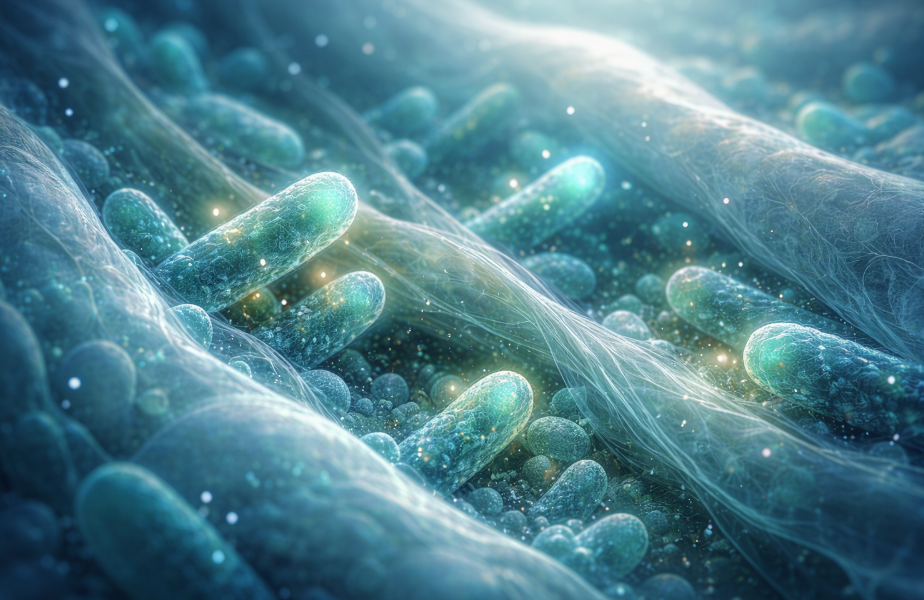
These microbes are not passive residents. They actively metabolize ammonia produced by the host’s waste products or by surrounding microbial communities. In doing so, they help regulate nitrogen availability in microenvironments that would otherwise accumulate toxic compounds.
Symbiosis, in this context, is not simply about coexistence. It represents a functional integration of microbial metabolism into the physiology and ecology of the host organism. Hosts provide habitat, stability, and a steady supply of ammonia, while microbes perform chemical transformations that benefit both the host and the surrounding ecosystem.
Why ammonia oxidation matters inside hosts
Ammonia is a natural by-product of protein metabolism. Marine animals excrete ammonia as waste, and in enclosed or poorly mixed environments, ammonia accumulation can be harmful. Symbiotic ammonia-oxidizing microbes help mitigate this problem by rapidly converting ammonia into less toxic compounds.
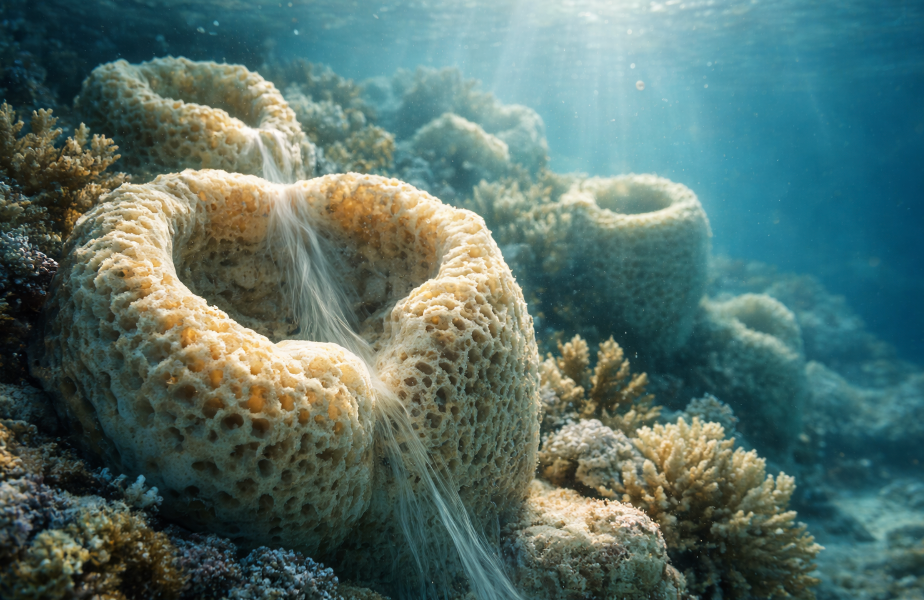
In some host organisms, particularly sponges, ammonia oxidation may play a role in maintaining internal chemical balance. Sponges filter vast volumes of seawater, concentrating organic matter and microbes within their tissues. The presence of ammonia-oxidizing symbionts allows sponges to process nitrogen internally rather than relying solely on surrounding microbial communities.
Beyond detoxification, ammonia oxidation may contribute to nutrient recycling within host-associated microbial consortia. Nitrite and nitrate produced by ammonia oxidation can fuel additional microbial processes, linking nitrogen transformation directly to carbon cycling and energy flow.
Diversity of ammonia-oxidizing symbionts
One of the striking findings highlighted in the review is the diversity of organisms capable of symbiotic ammonia oxidation. Both bacteria and archaea participate in this process, with ammonia-oxidizing archaea often dominating in oligotrophic (nutrient-poor) environments.
These microbes possess specialized enzymes that allow them to extract energy from ammonia oxidation, even at extremely low concentrations. This ability makes them particularly well suited to life within host tissues, where ammonia levels may be low but consistent.
Different host species harbor distinct microbial communities, and even closely related hosts may support different ammonia-oxidizing partners. This variability suggests that symbiotic ammonia oxidation has evolved multiple times and may be shaped by host physiology, habitat, and evolutionary history.
Expanding the geography of nitrogen cycling
The presence of ammonia oxidation within animal hosts expands the spatial scale at which nitrogen cycling occurs. Instead of being confined to water columns or sediments, key nitrogen transformations now occur within living organisms distributed throughout marine ecosystems.
This expansion has important implications for how scientists model nutrient cycles. Traditional models often assume that microbial processes are spatially homogeneous or limited to specific environmental compartments. Symbiotic ammonia oxidation challenges this assumption, revealing that nitrogen cycling is deeply embedded within biological structures.
In reef systems, for example, symbiotic ammonia oxidation within sponges and corals may influence local nutrient availability, affecting primary production and community composition. In pelagic systems, associations with jellyfish or zooplankton could create mobile hotspots of nitrogen transformation.
Connections to carbon cycling
Nitrogen and carbon cycles are tightly linked. Primary producers require nitrogen to build biomass, and microbial processes that transform nitrogen often influence carbon fixation and respiration. Some ammonia-oxidizing microbes are capable of chemoautotrophy, using energy from ammonia oxidation to fix carbon dioxide into organic matter.
When ammonia oxidation occurs within host-associated microbial communities, it may contribute to localized carbon fixation, altering the flow of carbon through ecosystems. While the magnitude of this contribution remains an open question, it highlights the interconnectedness of biogeochemical cycles.
Understanding these connections is particularly important in the context of climate change. Ocean warming, acidification, and deoxygenation are altering microbial metabolism and nutrient availability. Symbiotic ammonia oxidation may respond differently to these changes than free-living processes, potentially buffering or amplifying ecosystem responses.
Environmental change and symbiotic nitrogen processing
The review emphasizes that much remains unknown about how symbiotic ammonia oxidation responds to environmental stressors. Rising temperatures can alter metabolic rates, oxygen availability, and host physiology, all of which influence microbial activity.
Ocean acidification may affect the chemical equilibrium between ammonia and ammonium, altering substrate availability for ammonia-oxidizing microbes. Deoxygenation, increasingly common in coastal and open-ocean regions, could constrain nitrification, which typically requires oxygen.
Understanding how symbiotic ammonia oxidation behaves under these conditions is critical for predicting future changes in marine nutrient cycles. Hosts and microbes may respond differently to stress, potentially reshaping symbiotic relationships or shifting nitrogen pathways.
Knowledge gaps and future directions
Thomas and Garritano identify several major gaps in current understanding. These include the quantitative contribution of symbiotic ammonia oxidation to total nitrogen cycling, the mechanisms by which microbes colonize and persist within hosts, and the extent to which hosts actively regulate microbial activity.
Another open question concerns evolutionary dynamics. Did symbiotic ammonia oxidation evolve primarily as a detoxification mechanism, or did it arise as a mutualistic nutrient-sharing strategy? How stable are these relationships over evolutionary timescales, and how do they respond to environmental change?
Advances in genomics, imaging, and isotope tracing are beginning to provide tools to address these questions. As researchers continue to integrate microbial ecology with organismal biology and ecosystem science, symbiotic ammonia oxidation is likely to become a central concept in marine biogeochemistry.
Rethinking the scale of ecosystem function
Perhaps the most profound implication of this research is conceptual. It challenges the idea that ecosystems can be understood solely by studying free-living organisms and abiotic processes. Instead, it emphasizes that ecosystem function emerges from intimate biological partnerships operating at microscopic scales.
Symbiotic ammonia oxidation demonstrates that large-scale ecological patterns — nutrient availability, productivity, and biogeochemical fluxes — can be shaped by interactions invisible to the naked eye. These interactions blur the boundaries between organism and ecosystem, revealing a deeply interconnected marine world.
Conclusion: the quiet chemistry beneath the waves
Symbiotic ammonia oxidation is not a dramatic process. It produces no visible blooms, no sudden color changes, no obvious ecological spectacles. Yet it is one of the quiet chemical transformations that sustain life in the ocean.
By expanding the known geography of nitrogen cycling and embedding key transformations within living hosts, symbiotic ammonia oxidation reshapes how scientists understand marine ecosystems. It highlights the importance of microbial partnerships, the integration of physiology and biogeochemistry, and the hidden complexity beneath the ocean’s surface.
As climate change continues to alter marine environments, understanding these invisible processes will be essential. The future of ocean productivity, resilience, and stability may depend as much on microscopic symbionts as on the organisms we can see.