I. A Pastel Horizon — Where Earth Meets Infinity
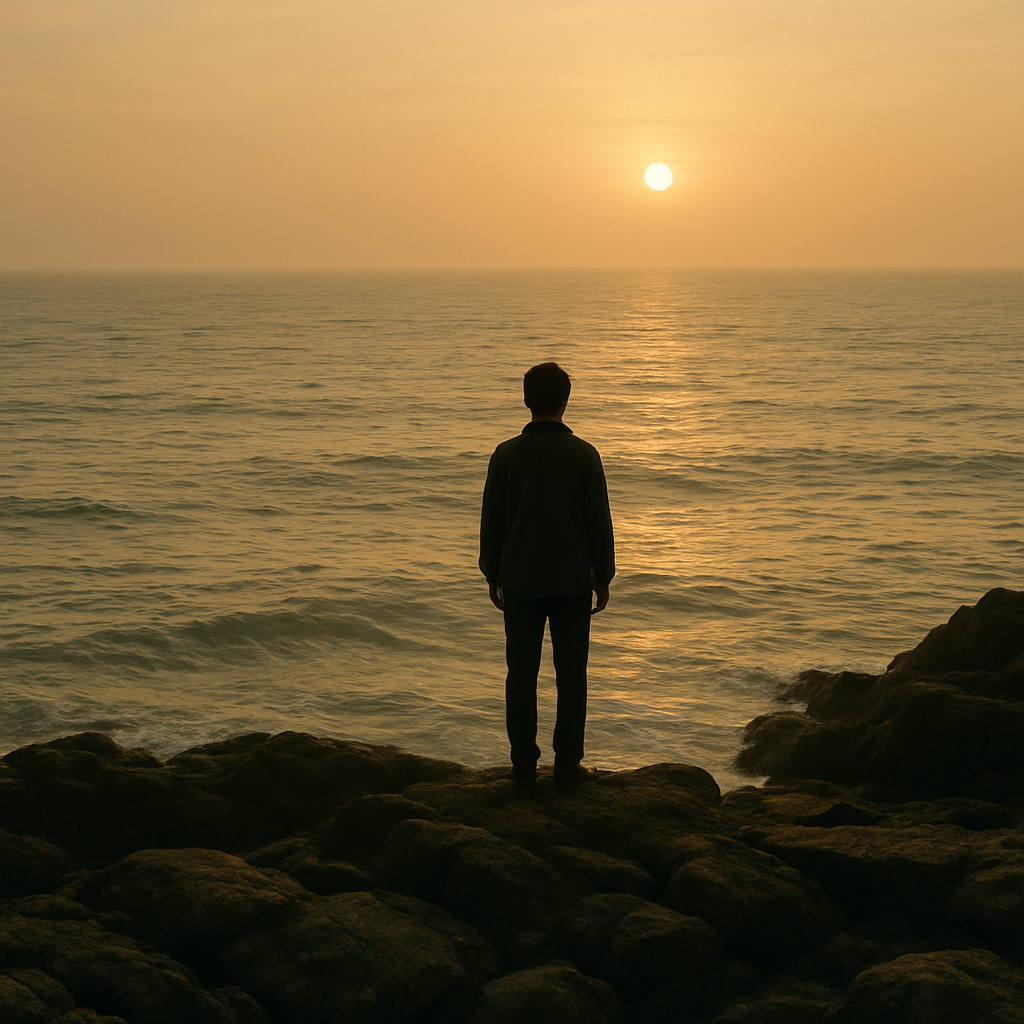
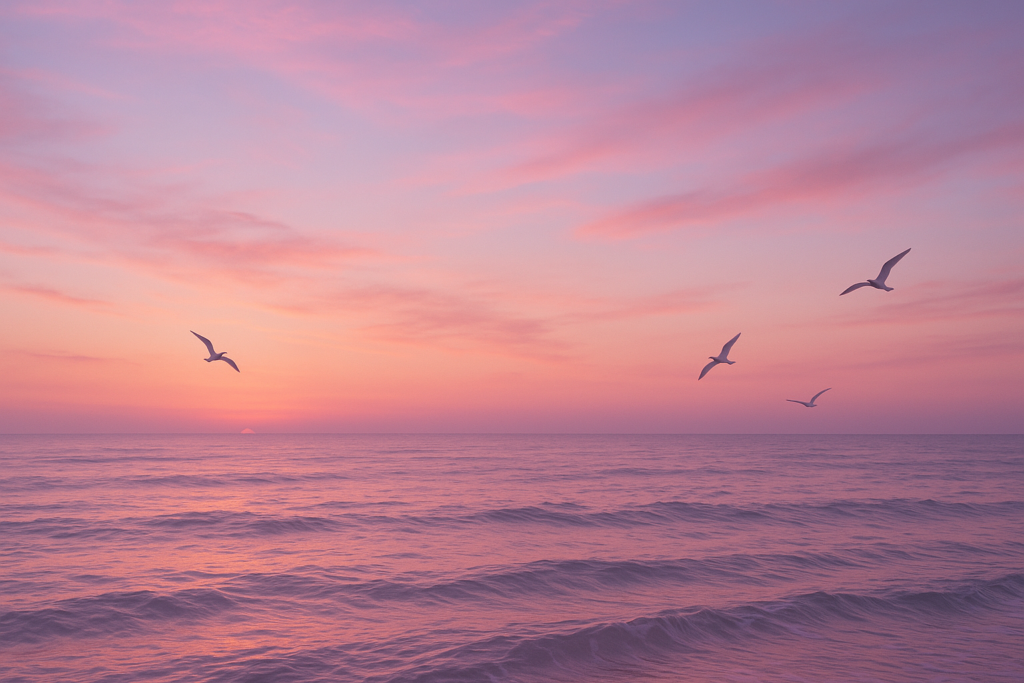
The sun sinks low, dissolving into the water like a dream.
Soft ribbons of pink and violet stretch across the sky, melting into the glassy surface of the sea. Waves roll in slow and rhythmic, brushing the sand with white foam — the whisper of something ancient and eternal. The air carries salt and silence, and for a moment the entire world seems to breathe in time with the tide.

Standing at the edge of the ocean feels like standing at the edge of understanding itself — that vast border between what we know and what we can only feel. The sea, endlessly shifting, is both mirror and mystery. Every ripple tells a story written not in ink, but in movement: the slow pulse of a planet alive.
This is where life began. Before trees reached skyward or wings beat against the air, there was the ocean — cradle, creator, and constant companion. Its rhythms shape the world still, governing weather, climate, and even the patterns of our own hearts. To understand the sea is to glimpse the hidden architecture of life itself.
II. The Pulse of the Planet — Tides and Time
The sea does not move randomly; it breathes. Its inhalations and exhalations are the tides, drawn by the gravity of the Moon and the Sun.
Twice a day, oceans rise and fall in a choreography billions of years old. On shores around the world, this pull writes invisible poetry across the sand — a cosmic rhythm connecting the heavens and the Earth. The Moon, though small, tugs the entire mass of the ocean ever so slightly, creating bulges of water that chase it around the globe. When the Sun joins in alignment, tides surge higher — the “spring tides.” When the forces oppose, they ebb gently — “neap tides.”
To coastal creatures, this is not just background motion — it is life’s metronome. Crabs scuttle out with the receding water, feeding before the flood returns. Shorebirds time their hunts to low tide, probing wet sand for worms. Even some coral species release eggs and sperm during specific tidal windows, synchronizing reproduction with lunar cycles.
Humans, too, have long felt this pull. Ancient navigators tracked tides to predict safe harbors. Fishermen read them as scripture. In many cultures, the Moon’s influence over the sea became a metaphor for the connection between the physical and the spiritual — the way unseen forces move through all living things.
The tides are time embodied. They remind us that every motion — no matter how immense — has a rhythm, a pattern, and a purpose.
III. Invisible Highways — Ocean Currents and Global Balance
Beneath the surface, another kind of rhythm flows: the ceaseless movement of ocean currents. These are the arteries of the planet, transporting heat, nutrients, and life itself.
The Gulf Stream, for example, begins in the Caribbean, carrying warm tropical water up the eastern coast of North America and across the Atlantic. Without it, Europe’s climate would be far colder and harsher. This river within the sea moderates global weather patterns and ensures that energy from the equator reaches the poles.
Deeper still, a slow-moving circulation known as the “global conveyor belt” connects all the world’s oceans into a single vast system. It can take over a thousand years for a single drop of water to complete this journey — sinking in the frigid North Atlantic, flowing through the deep abyss, and resurfacing in the Pacific or Indian Ocean.
This hidden motion governs the climate and sustains marine life. Upwelling zones, where cold nutrient-rich water rises to the surface, create some of the most productive ecosystems on Earth — teeming with plankton, fish, and whales. These invisible patterns are the planet’s thermoregulation system, keeping the climate stable — until now.
As global temperatures rise, these currents are shifting. Melting polar ice dilutes seawater, changing its density and slowing circulation. If disrupted, entire climate systems could falter. Europe might freeze even as the tropics overheat. Monsoons might fail. The rhythm could be lost — and with it, the balance of the world’s breath.
IV. The Web Beneath the Waves — Life’s Hidden Architecture
To stand on the shore is to see only the surface of a vast, living cathedral. Beneath lies a network of ecosystems as intricate and beautiful as any forest, each sustaining the next.
Plankton — The Tiny Titans
The true foundation of oceanic life is nearly invisible. Phytoplankton — microscopic, plant-like organisms — drift near the surface, turning sunlight into energy through photosynthesis. They generate more than half of the planet’s oxygen — more than all forests combined — and form the base of the marine food web.
Zooplankton, their animal counterparts, feed on phytoplankton and in turn nourish small fish, krill, and jellyfish. From there, energy flows upward — to tuna, sharks, seals, seabirds, and ultimately to humans. Each breath we take, each heartbeat, is touched by plankton’s quiet labor.
Coral Reefs — The Rainforests of the Sea
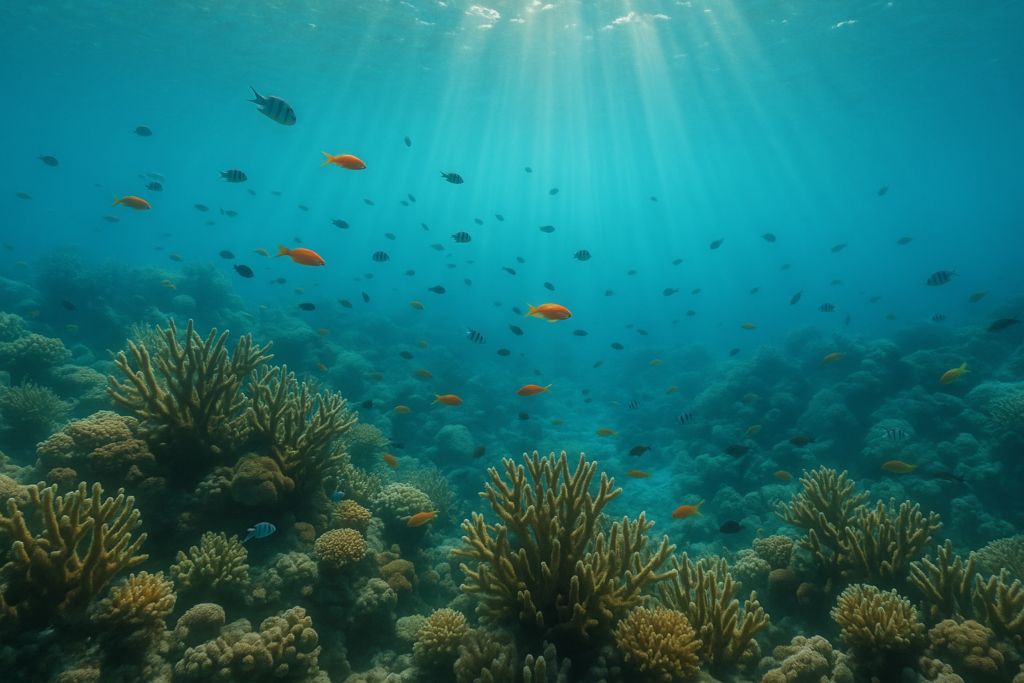
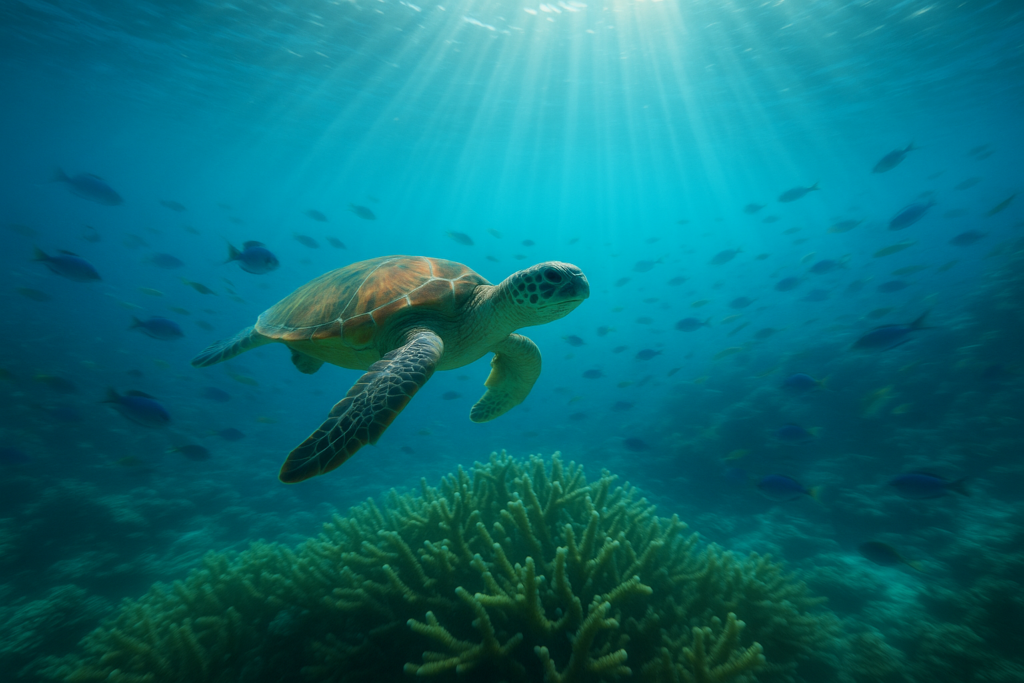
Further along the tropics, coral reefs blaze with life. Built by colonies of tiny coral polyps, these reefs are ancient architects, creating limestone structures that can stretch for thousands of kilometers. Within their crevices dwell a quarter of all marine species — from neon-colored fish to camouflaged octopuses and grazing sea turtles.
Yet, coral reefs are among the most threatened ecosystems on Earth. Rising ocean temperatures cause coral bleaching, forcing corals to expel the symbiotic algae that give them color and life. Without urgent action, half of the world’s reefs could disappear within decades.
Kelp Forests and Seagrass Meadows
In cooler waters, kelp forests sway like underwater jungles. These towering brown algae create nurseries for fish, sea otters, and crustaceans, absorbing carbon and buffering coastlines from storms. Seagrass meadows, though less dramatic, perform a similar role — stabilizing sediment, filtering water, and sequestering carbon at astonishing rates.
Each of these ecosystems — plankton blooms, coral gardens, kelp forests — is a note in the ocean’s grand symphony. Together, they maintain the delicate balance of life on Earth.
V. Climate Custodian — The Ocean’s Role in Regulating Earth
The ocean is not just a body of water — it is the planet’s most powerful climate machine. Covering over 70% of Earth’s surface, it absorbs about 90% of the excess heat generated by greenhouse gases. It also acts as a carbon sink, drawing in roughly a quarter of the carbon dioxide we emit.
Through these processes, the ocean slows the pace of climate change — but not without cost. The more carbon it absorbs, the more acidic it becomes. Ocean acidification dissolves shells, weakens coral skeletons, and alters marine food webs. Heat absorption drives more intense storms and disrupts migration patterns.
Yet, this same resilience reminds us of the ocean’s generosity. For all the damage done, it continues to buffer, stabilize, and nurture life. Understanding this duality — the ocean as both protector and patient — is key to understanding our relationship with it.
VI. The Human Connection — Art, Myth, and the Sea Within
Long before satellites mapped the sea’s currents or scientists measured its salinity, humanity looked to the ocean with reverence and awe.
In Greek mythology, Poseidon ruled the seas — tempestuous and powerful, both giver and taker of life. Polynesian voyagers honored Tangaroa, god of the ocean, as the origin of all creatures. In Japanese Shinto tradition, sea kami such as Watatsumi embodied nature’s sacred energy.
Every coastal culture has a story about the sea — because it has always reflected our own depths. It is where we face mystery, surrender control, and find renewal.
Artists and writers have long drawn from the ocean’s palette. J.M.W. Turner painted its fury; Virginia Woolf captured its melancholy pulse in The Waves. To poets like Pablo Neruda, the sea was both mirror and muse — a reminder that even chaos can contain beauty.
But our relationship with the ocean is not only emotional — it’s existential. Every breath of oxygen, every rainfall, every bite of seafood ties us to it. The ocean lives inside us, in our cells, our blood, our language. Its salt mirrors our own.

VII. The Ocean in Peril — A Fragile Giant
Today, the ocean faces more pressure than at any time in human history.
Plastic pollution chokes its surface and depths alike — from drifting bottles to microscopic particles now found in plankton and fish. Overfishing has stripped ecosystems bare, collapsing food webs built over millennia. Warming temperatures bleach coral reefs and drive species toward extinction. Coastal development erases mangroves and wetlands, the nurseries of the sea.
And yet, hope endures. Around the world, conservationists, scientists, and communities are working to heal the water’s wounds. Marine protected areas are expanding. Coral nurseries are restoring damaged reefs. Bans on deep-sea trawling and single-use plastics are gaining ground.
In 2023, the United Nations adopted the High Seas Treaty, aiming to protect international waters beyond national borders — a monumental step toward planetary stewardship. But protection begins not only in policy, but in perception. We must once again see the ocean as alive — not a resource, but a relationship.
VIII. Reconnection — Listening to the Sea
To stand at the shore at dawn, when the air is cool and the horizon blushes awake, is to remember something ancient. The rhythm of the waves is not just sound — it is memory. It calls us back to the origin of all things.
Scientists can measure tides, map currents, and decode ecosystems — yet the ocean’s true wisdom lies in its constancy. It reminds us that all life is connected, that every drop of water has been part of clouds, rivers, and veins. The sea teaches patience, balance, and humility — lessons humanity urgently needs.
In learning its science, we must not lose its soul. For to love the ocean fully is to blend curiosity with care, data with devotion, reason with reverence.
IX. The Call of the Deep — Protecting What Protects Us
The ocean has given us everything — life, breath, beauty, and belonging. Now, it calls for reciprocity.
We can answer through small actions that ripple outward:
- Reduce plastic waste by choosing reusables.
- Support sustainable seafood and avoid overfished species.
- Join or donate to marine conservation organizations.
- Vote and advocate for policies that protect coastlines and curb carbon emissions.
- Rewild our awareness — spend time by the sea, learn its names, know its moods.
Collectively, these gestures form a tide of change — one powerful enough to turn despair into restoration.
Because the ocean’s story is not finished. It still sings beneath the surface, still glows with plankton light and coral color. The rhythm remains, waiting for us to listen again.
X. Epilogue — The Sea Within Us
As the day fades and the last light lingers on the horizon, the waves continue their eternal pulse — slow, steady, unbroken.
The ocean does not ask for perfection, only presence. To look upon it is to remember that we are not separate from the Earth, but expressions of it — like waves are expressions of the sea.
In the rhythm of the tides, the drift of currents, and the hush of twilight surf, there is both origin and omen. The sea reminds us that life moves in cycles, that renewal follows loss, and that the smallest ripple can reshape the shore.
The ocean is vast, yes — but so is our capacity for wonder, compassion, and change. If we listen closely, we can still hear its heartbeat, echoing through time.
It beats in the waves, and it beats in us.