
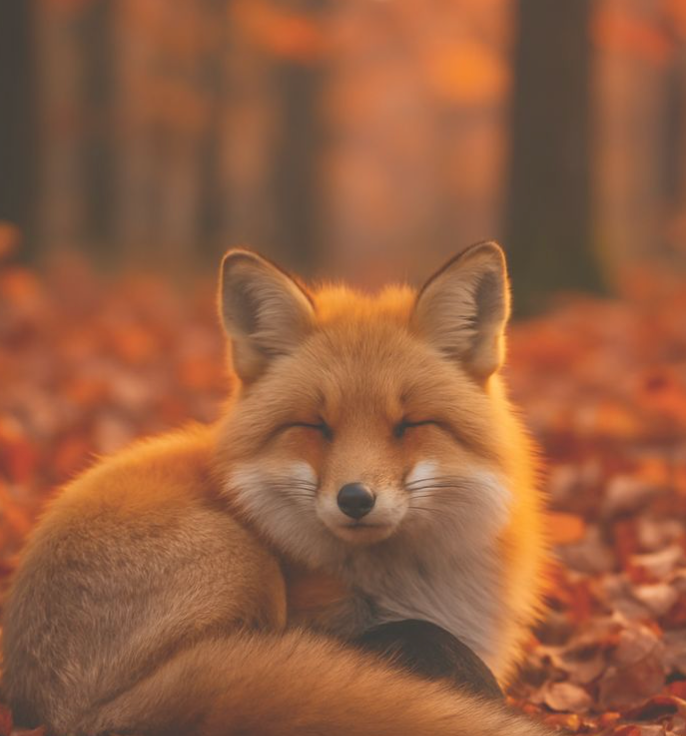
The fox is asleep.
Curled gently into a russet circle, its tail wrapped around its body like a warm ember, it rests among a scattered quilt of fallen leaves. The autumn forest holds its breath around this moment — shafts of golden light filtering through the thinning canopy, each ray catching the soft rise and fall of the fox’s breath. The leaves beneath it rustle with the slightest breeze, releasing scents of earth, cinnamon-damp soil, and the sweetness of decay. A quiet symphony of distant chirps, acorn thuds, and the barely audible whisper of shifting branches surrounds the sleeping animal.
If you were to come upon this fox, you might pause.
You might soften.
You might feel something ancient awaken in your chest — a kind of remembering.
Because this is what wild things do:
they remind us of stillness, of presence, of the gentle cadence of the natural world that our modern lives often drown out.
So let us sit with the fox awhile.
Let us begin in this forest, in this season of change, and follow the threads of life woven through leaf, fur, root, feather, claw, and soil.
For in the curled fox lies a doorway — into the stories, science, secrets, and sacred rhythms of temperate forests, and into the deeper knowing that when we understand the lives of animals, we understand something essential about ourselves.
Part I: Autumn’s Embrace — The Forest as Sanctuary
The Sensory Landscape of Fall
Autumn is a season of softness and preparation.
The sunlight turns honey-warm, slanting through trees at angles that feel almost tender. Leaves shift into burning colours — ochre, flame-red, umber, bronze — each one a tiny lantern fallen from a fading canopy. The air is crisp and carries the scent of woodsmoke, moss, and the subtle mineral tang of changing weather. Fungi push through leaf litter in clusters of cream, orange, and brown, feeding on the forest’s slow decomposition.
The forest feels like a world exhaling.
A lullaby.
A threshold.
Every creature, from the fox curled beneath the maple to the owl perched silently above, senses the shift. Days shorten. Nights stretch. Food must be gathered. Territories must be reinforced. Young animals must learn their final lessons before winter arrives.
Autumn is a golden pause — the moment between abundance and endurance.
And it is here, in this glowing interlude, that the fox rests.
Part II: The Life of a Fox — Adaptation, Elegance, and Wild Intelligence
A Creature Built for the Between-Spaces
The red fox (Vulpes vulpes) is a master of edges — the margins where forest meets meadow, where wild meets rural, where night meets day. They thrive in these in-between spaces, navigating them with the grace of dancers and the intuition of seasoned survivalists.
Their physiology is a testament to adaptation:
- Large, triangle-shaped ears that funnel sound like satellite dishes
- Slender limbs made for silent travel
- A bushy tail (bushy enough to act as insulation) that doubles as a pillow and a communication tool
- Eyes with vertical pupils that maximize low-light sensitivity
- A nose capable of detecting prey beneath snow
Foxes live in a world attuned to subtlety — the crunch of a vole under bark, the scent trail left hours earlier by a rabbit, the faintest rustle of a bird landing on a branch.
To understand a fox is to understand the art of awareness.
Foraging: The Dance Between Hunger and Strategy
The fox hunts with poetry.
Watch closely and you will see:
- the slow lift of a paw
- the tilt of the head
- the sudden stillness
- the moment of calculation
- the high, arcing leap — the iconic “mousing pounce”
Scientists believe foxes use Earth’s magnetic field as a targeting guide, aligning themselves north-east to improve hunting accuracy. Yet even without technical explanations, the act is mesmerizing — a blend of instinct, physics, and pure elegance.
Foxes eat what the forest offers:
- rodents
- insects
- berries
- fallen fruit
- birds
- eggs
- even fungi
They are opportunistic omnivores, sculpting their diets around the seasons.
Communication: A Language of Body and Sound
Fox communication is layered — soft, nuanced, emotional.
Their vocabulary includes:
- gentle “gekker” chatter during courtship
- barks that serve as territorial warnings
- high screams used in mating season
- whines from kits seeking food
- tail signals conveying dominance, submission, or play
Foxes speak through movement as much as sound — a lowered head, a curved spine, a flick of the tail.
Their language is subtle and rich, like whispers between wind and leaf.
Family: The Den as World
Fox families — called leashes or skulks — are built on cooperation.
A mated pair may raise their kits together, sometimes with older siblings assisting. Dens dug beneath roots or boulders become safe havens filled with warmth, playful chaos, and tender grooming rituals.
Kits spend their early weeks tumbling in soft grasses, learning through curiosity and mimicry. Their play teaches them future skills — hunting, boundaries, agility, communication.
By autumn, young foxes are nearly grown.
They venture farther, test their independence, and eventually set out to carve their own territories.
And so the cycle continues:
rest, birth, growth, departure.
The fox curled in the leaves is part of this ancient rhythm.
Part III: Beneath the Leaves — The Hidden Worlds of Forest Species
Small Lives, Great Importance
While the fox slumbers, the forest bustles quietly around it.
Mice and Voles
Tiny mammals scurry beneath the leaf litter, following tunnels they’ve carved through grass and soil. They cache seeds to fuel them through winter — acorns, beech nuts, maple seeds. Their populations rise and fall in cycles that ripple through the entire ecosystem.
Birds of the Understory
Sparrows, robins, and wrens flit among low branches searching for insects stirred by falling leaves.
Woodpeckers drum for beetle larvae hidden beneath bark.
Owls observe from darkened perches, waiting for dusk to begin their silent patrol.
Insects and Decomposers
Beetles break down fallen wood.
Centipedes hunt small prey under rotting logs.
Earthworms churn soil into fertile layers.
Fungi web through the ground in immense, unseen networks.
These life-forms are tiny architects of the forest’s health.
The Deer and the Herbivores
White-tailed deer move softly through the understory, noses low as they search for late-season forage. Their grazing shapes plant communities and influences which seedlings survive.
The Apex and the Watchers
Somewhere beyond, a coyote trots along a ridge.
A bobcat slips between shadows.
A hawk circles silently overhead.
Each species — predator, prey, herbivore, omnivore, decomposer — contributes to balance.
A forest is a symphony.
Remove one instrument, and the entire sound changes.
Part IV: The Science of Seasons — Cycles of Change, Memory, and Balance
Autumn as a Biological Clock
Falling temperatures and shortening daylight trigger a cascade of changes:
- Trees withdraw nutrients from leaves, prompting fall colour.
- Animals shift their diets.
- Insects slow metabolism.
- Birds migrate along ancient flyways.
- Predators adjust hunting patterns.
Autumn is the forest preparing its long exhale — the preparation before winter’s stillness.
Predator–Prey Dynamics: A Dance of Survival
Foxes are mid-level predators, shaping rodent populations and indirectly influencing seed dispersal. Their success determines the abundance of certain plants. In turn, owl numbers depend on prey that foxes help regulate.
Ecology is interdependence made visible.
No species lives alone.
All species live in relationship.
The Slow Pulse of Woodland Ecology
Temperate forests breathe in decades, centuries, millennia:
- Oaks rise over a century.
- Soil forms over thousands of years.
- Fungal networks grow silently beneath every step.
- Fox territories shift subtly year to year.
Seasonal cycles are the clockwork of these long-lived systems — mechanisms of balance, renewal, and resilience.
Part V: Stories in Fur and Feather — Other Creatures of the Forest
The Owl: Silent Hunter of the Dusk
Owls glide on wings designed for silence — serrated edges breaking turbulence into whisper-light flight. Their hearing is so acute they can pinpoint prey beneath snow by sound alone. In mythology, owls symbolize wisdom, intuition, night-sight — qualities that mirror the forest’s hidden nature.
The Bear: Keeper of Cycles
Black bears gorge on berries, nuts, and late-autumn acorns before entering hibernation. Their sleep is not death-like but a deep metabolic slowing. Bears embody the forest’s lesson of rest — the importance of withdrawal and renewal.
The Wolf or Coyote: Guardians of Balance
Where present, wolves regulate herbivore numbers, allowing forests to regenerate. Coyotes fill similar roles in landscapes where wolves are absent. These predators prevent ecological unraveling.
The Raven: Messenger of the Woods
Ravens play, solve puzzles, remember faces, and communicate across impressive distances. Their presence signals intelligence woven into the forest’s fabric.
The Deer: Grace on Four Legs
Their movements are poetry — slow, deliberate, alert. Deer shape the understory and support predators, linking plant and carnivore communities.
Each species is a verse in the forest’s ongoing poem.
Part VI: Philosophy of the Wild — What Animals Teach Us
Presence
A fox does not rush.
A deer does not multitask.
An owl does not worry about tomorrow’s hunt until twilight arrives.
Wild animals live fully in each moment — wholly attuned to sound, scent, movement, temperature. Watching them reminds us of the mindfulness we have forgotten.
Integration
Animals exist within the world, not outside it.
They do not conquer their environment — they respond to it.
Their survival depends on respect, balance, and adaptation.
Humans once lived this way too.

Seasonal Wisdom
The forest teaches:
- to grow in spring
- to flourish in summer
- to let go in autumn
- to rest in winter
Modern life has broken these rhythms — but nature still offers them freely.
Humility
To kneel beside a curled fox is to feel your own smallness — not in a diminishing way, but in a grounding one. The forest does not need us, but we need the forest.
Interdependence
Ecology teaches that no creature’s life is solitary. Everything is woven:
- The fox eats the vole
- The vole eats the seed
- The seed grows into a tree
- The tree supports the forest
- The forest sustains the fox
We are part of that web too.
Part VII: Travel Through the Forest — A Narrative of Connection
Imagine walking along a quiet autumn trail at dawn.
Mist rises from the ground, clinging to your ankles like soft breath from the earth. Leaves crunch beneath your boots. A distant woodpecker taps out a staccato rhythm. Light slants across mossy logs in golden beams.
Then — a sudden pause.
A rustle of leaves.
A flash of red.
A fox emerges.
It looks at you — ears alert, whiskers forward, black legs poised.
You stay still.
Not holding your breath, but breathing gently.
The fox does not flee immediately. It observes. Calculates.
Decides.
And then slips away like a ghost wearing autumn colours.
Your heart beats a little faster.
You feel something inexplicable — a connection stitched quietly between two worlds.
This moment will stay with you longer than the trail map, longer than the day’s itinerary, longer than many of your planned destinations.
Because encounters with the wild remind us of a truth deeper than travel:
To meet an animal’s gaze is to remember our own place in the story of life.
Part VIII: The Hidden Teachings of Temperate Forests
The Forest as Community
Every species — from fox to fungus — is part of a communal tapestry.
Mycorrhizal networks connect trees underground.
Beavers shape water systems.
Insects pollinate flowers.
Predators maintain population balance.
This is ecological harmony — a living partnership.
The Forest as Archive
Tree rings hold histories of drought and abundance.
Soil layers hold stories of glaciers and fires.
Animal tracks reveal nightly journeys.
Ecosystems are books written in feather and fur, root and stone.
The Forest as Teacher
Temperate woodlands teach resilience —
burn, regrow, adapt.
They teach patience —
seasons are slow artists.
They teach integration —
life and death are not opposites but collaborators.
The Forest as Philosopher
Autumn reminds us that beauty and loss coexist.
Winter reminds us that rest is essential.
Spring reminds us that beginnings are possible.
Summer reminds us to flourish while we can.
Part IX: Conservation, Coexistence, and What the Fox Teaches Us About Ourselves
Why Understanding Matters
When you learn the life of a fox, you begin to care.
When you understand an owl’s hunting, you protect its habitat.
When you know a forest is not a collection of trees, but a web of relationships, you defend it.
Knowledge becomes empathy.
Empathy becomes action.
The Threats to Forest Life
Temperate woodlands face challenges:
- habitat loss
- fragmentation
- climate change
- invasive species
- declining prey populations
- human-wildlife conflict
Foxes adapt well — but adaptation has limits.
Many species have less flexibility.
Coexistence Begins with Vision
If we choose:
- to preserve corridors
- to allow forests to age
- to reduce chemical pollutants
- to protect predator species
- to respect wildlife boundaries
— then the fox can continue sleeping in autumn forests, and the world remains richer for its presence.
Seeing Animals as Teachers
The fox teaches awareness.
The deer teaches gentleness.
The owl teaches patience.
The bear teaches rest.
The raven teaches curiosity.
The forest teaches belonging.
We are not separate from nature.
We are made of the same elements — breath, blood, carbon, memory.
To protect the wild is to protect ourselves.
Conclusion: The Fox in the Leaves — A Lesson in Being Alive
Return now to the sleeping fox.
The forest glows around it — warm, quiet, breathing. A leaf drifts onto its tail. A breeze lifts a few strands of fur. Somewhere above, a jay calls out, sharp and clear.
The fox shifts slightly but does not wake. It is safe here. It is part of this place. It belongs.
And so do you.
This forest, with its rustling leaves, hidden tunnels, ancient rhythms, and soft-furred teachers, is part of your story too. To understand the wild is to understand the quiet hunger inside us for connection, for slowness, for meaning, for presence.
Because when you watch a fox sleep under autumn trees, you remember:
Life is fragile.
Life is interconnected.
Life is astonishing.
Life is worth protecting.
And maybe — just maybe — the wild animals of this world are trying to show us how to be human again.