
The moment begins quietly.
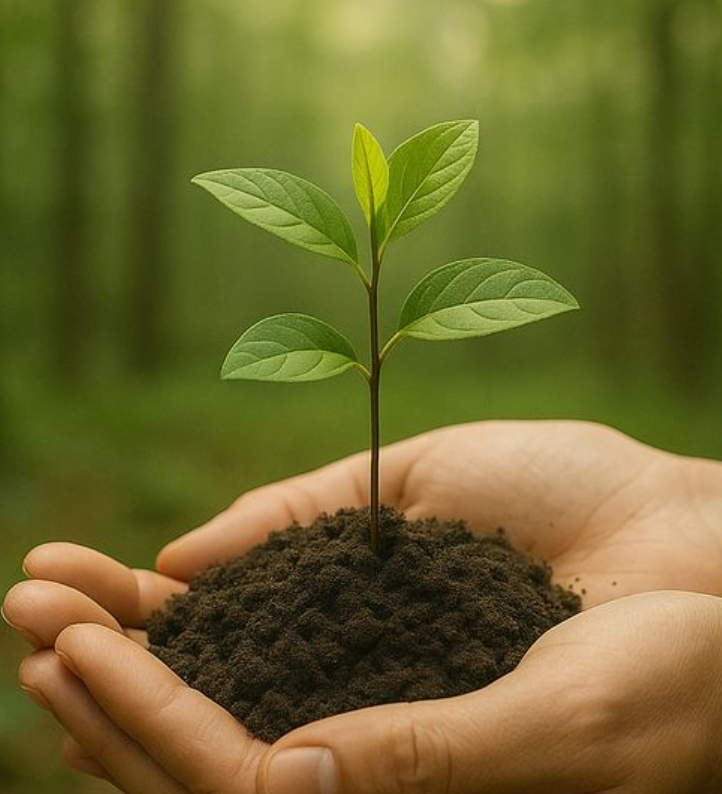
Your hands sink into the soil — warm, dark, alive. The earth is soft, crumbly, and fragrant with a smell older than language: the scent of decomposition and renewal, of minerals and microbes, of everything that has died and everything that will be reborn. Between your fingers, the soil feels textured, grainy yet yielding, tiny particles shaped by centuries of rain, roots, frost, and the slow work of unseen organisms.
In your palm rests a seed.
Small enough to forget in your pocket. Light enough to blow away with a sigh. Yet astonishing in its completeness — a universe folded into a shell. It contains its own blueprint, its own timing, its own quiet hunger for light.
You lower the seed into the soil and cover it gently.
It disappears from view, beginning the ancient, invisible work of becoming.
In that simple act — placing a living future into the hands of earth — there is something profoundly hopeful. Planting a seed is a whisper of belief:
In growth.
In renewal.
In care.
In the possibility of healing a wounded world.
This is where our story begins.
With a seed.
With soil.
With hands connecting us to the ground that sustains us.
But the story expands outward — from the microscopic magic beneath our feet to the towering complexity of global forest ecosystems, and finally to the work humans are doing to restore and protect the lungs of the planet.
Because in the end, planting a seed is not only about giving life to a tree.
It is about remembering that we, too, are capable of regrowth.
Part I: The Seed — A World Inside a Shell
The Quiet Architecture of Life
A seed is a paradox: small but infinite, fragile but powerful, dormant yet ready to explode into motion. Encased within its protective coat lies:
- an embryo
- a food reserve
- genetic instructions
- chemical signals
- the potential to become forest, shade, habitat, oxygen, carbon-storage, future
Seeds evolved hundreds of millions of years ago — a triumph of evolution that allowed plants to travel, wait, and colonize new environments.
Some seeds sprout within days.
Others wait for years, even centuries, until the right conditions call them awake.
Germination — The Miracle of Awakening
The process begins when moisture reaches the seed:
- Imbibition:
Water enters, hydrating tissues and swelling the seed. - Enzymatic awakening:
Stored starches convert into sugars; metabolism sparks into being. - Root emergence (radicle):
The very first root pushes downward, anchoring the plant to earth. - Shoot emergence (plumule):
A fragile stem rises, carrying leaves that unfurl like tiny green flags.
All of this happens in silence.
In darkness.
Under the soil, where no one sees.
Every forest begins with this private miracle.
The Seedling — Soft Yet Unstoppable
As roots deepen, the plant begins to claim its place:
- pushing through packed soil
- dividing cells rapidly
- orienting itself to light
- balancing water intake
- forming early partnerships with microscopic soil allies
The seedling is small, but its trajectory is immense.
It reaches upward not only for survival, but for possibility.
Part II: The Soil — A Universe Beneath Our Feet
Soil Is Not Dirt
Soil is not inert.
It is alive — a bustling underground metropolis.
One teaspoon of healthy soil contains:
- billions of bacteria
- meters of fungal hyphae
- protozoa
- nematodes
- arthropods
- microaggregates
- minerals
- humus (organic matter)
Soil holds the memory of ecosystems.
It carries the nutrients of ancient forests, the ashes of old fires, the remains of creatures long gone, transformed into nourishment for future life.
Mycorrhizal Networks — The Wood-Wide Web
One of the most extraordinary discoveries in modern ecology is the existence of mycorrhizal networks — symbiotic relationships between plant roots and fungi.
These fungi colonize roots, extending far into the soil, forming vast, interconnected webs that:
- transport nutrients
- share carbon between trees
- relay chemical warnings
- support seedlings
- stabilize soil structure
- act as communication highways
A seedling plugged into the wood-wide web is no longer alone.
It is connected to an ancient community.
Soil Structure — The Architecture of Fertility
Healthy soil requires:
- organic matter
- pore spaces for air and water
- fungal threads
- diverse microbes
- stable aggregates
Plants don’t just grow in soil; they shape it:
- roots break apart hard layers
- leaf litter feeds decomposers
- exudates attract beneficial bacteria
- fungal partnerships enrich nutrient availability
Forests are not simply collections of trees.
They are soil-making machines.
Part III: From Seedling to Forest — The Rise of Ecosystems

Light, Competition, and Growth
As plants grow, they compete for:
- sunlight
- water
- nutrients
- space
Some evolve tall trunks to reach light.
Others sprawl low to capture what seeps through the canopy.
Forests form when many plants, over centuries, negotiate these partnerships and rivalries until a stable, complex system emerges.
Diversity — The Secret to Strength
Healthy forests contain:
- canopy trees
- understory shrubs
- herbaceous plants
- mosses
- fungi
- insects
- mammals
- birds
- decomposers
Every layer supports the next.
Every lifeform plays a role.
The seed you plant contributes to a system far larger than itself.
Part IV: The World’s Forests — Life at Planetary Scale
From the first sprout to entire biomes, forests take many forms. Each plays a critical role in Earth’s climate, water cycles, and biodiversity.
1. Tropical Forests — Earth’s Green Heart
Found near the equator, these forests contain half of all species on Earth, despite covering less than 10% of land.
Key characteristics:
- high rainfall
- year-round growth
- layers of intense biodiversity
They store enormous amounts of carbon and regulate global weather patterns.
Tropical forests are also among the most threatened: logging, mining, agriculture, and fires erode them at alarming rates.
2. Temperate Forests — Seasonal Wonders
Located in North America, Europe, East Asia, and parts of Oceania, these forests experience:
- warm summers
- cold winters
- vibrant autumn foliage
- rich seasonal rhythms
Their diversity is moderate but beautiful: oaks, maples, birches, pines, fungi, foxes, deer, songbirds, salamanders.
Many temperate forests have been cleared historically, but restoration efforts are bringing them back.
3. Boreal Forests — The Great Northern Wilderness
Stretching across Canada, Alaska, Scandinavia, and Siberia, the boreal forest is Earth’s largest terrestrial biome.
Its traits:
- conifers dominate
- cold temperatures
- vast carbon stores in soil and peat
- wolves, moose, lynx, owls
The boreal forest is sometimes called Earth’s “carbon vault” — but warming threatens to release that stored carbon.
Part V: Global Cycles — Forests as Climate Engines
Forests regulate Earth’s systems in ways both visible and invisible.
The Carbon Cycle
Trees absorb CO₂, storing carbon in:
- wood
- bark
- leaves
- roots
- soil organic matter
Forests hold more carbon than the atmosphere.
Cutting forests releases centuries of stored carbon in months.
Planting and protecting forests is a powerful climate solution — but only if we safeguard long-term ecological health.
The Water Cycle
Forests:
- draw water from the soil
- release moisture through leaves (transpiration)
- create clouds
- generate rain
- regulate river flow
The Amazon creates its own rainfall, functioning as a giant atmospheric pump.
Biodiversity Support
Forests are biological libraries:
- seed banks
- genome reservoirs
- evolutionary cradles
Each species is a story millions of years old.
To lose them is to lose irreplaceable pages of Earth’s history.
Part VI: Restoration Ecology — Healing What Was Broken
Despite the devastation, restoration ecology offers genuine hope.
The Principles of Restoration
Effective restoration requires:
- native species
- soil rebuilding
- hydrology repair
- community involvement
- long-term monitoring
- protection from future degradation
Restoration is slow but powerful — a decades-long commitment.
Inspiring Real-World Success Stories
1. Costa Rica — National Rebirth
In the 1980s, Costa Rica was nearly deforested.
Today, more than half the country is forested again thanks to:
- Payments for Ecosystem Services (PES)
- ecotourism
- national parks
- community forestry
It is one of the greatest reforestation success stories in modern history.
2. China’s Loess Plateau — Turning Desert to Green
Massive erosion once devastated this region.
Through terracing, controlled grazing, and native planting, it transformed from barren land into thriving vegetation — improving livelihoods and reducing poverty.
3. The Great Green Wall of Africa
A Pan-African effort aiming to restore 8,000 km of degraded land across the Sahel.
Local communities lead the work, planting drought-resistant trees, improving soil, and stabilizing livelihoods.
4. Indigenous-Led Forest Stewardship
From the Amazon to Canada to Australia, Indigenous communities are restoring forests through:
- cultural burning
- seed harvesting
- sustainable timber practices
- traditional land care
Their generational knowledge is vital to global climate resilience.
Part VII: The Hope in Our Hands — What One Seed Can Become
By now, our story has expanded far beyond your hands in the soil.
But everything returns to that moment.
Because a seed is not just a plant.
It is a promise.
Why Planting Matters
When you plant a seed, you are participating in:
- carbon capture
- biodiversity support
- soil restoration
- local climate cooling
- pollinator habitat creation
- watershed protection
- future shade and beauty
Each tree becomes:
- a home for birds
- a barrier against erosion
- a sponge for water
- a generator of oxygen
- a sanctuary for insects
- a memory for the land
Even one tree alters the world around it.
Human Hands as Tools of Healing
We are capable of immense harm — deforestation, pollution, extraction.
But we are also capable of profound care.
Around the world, people are:
- restoring wetlands
- reviving coral reefs
- rewilding landscapes
- planting food forests
- protecting old-growth trees
- learning from Indigenous stewardship
Hope doesn’t ignore damage.
Hope says: we can still repair what remains.
Collective Action — The Forest of the Future
A seed becomes a tree.
A tree becomes a forest.
A forest becomes a climate solution.
A climate solution becomes a healed planet.
This is the math of hope.
Conclusion: The Seed We Carry
Return to the small seed in your hand — the moment of planting.
The soil embraces it.
Moisture seeps in.
Darkness nourishes.
The first root unfurls downward.
A shoot reaches upward, seeking light.
A life begins.
The world may feel fractured — forests burning, species declining, climates shifting — but this tiny act is a reminder that healing starts small.
A seedling does not fix everything.
But it changes something.
And enough small changes become transformation.
The future is not yet written.
Forests can return.
Ecosystems can recover.
Species can rebound.
Humans can learn to nurture rather than destroy.
And so we plant — not because we are certain of success, but because we choose to participate in life.
A seed is hope made tangible.
A tree is hope made visible.
A forest is hope made powerful.
And the planet we leave for future generations depends on the seeds — literal and metaphorical — that we choose to plant today.
Hands in the soil.
Heart open to the future.
Life begins here.