
The world is quiet here.
The Arctic morning is a soft, pale thing — the sun low on the horizon, never fully rising in winter, but spreading gentle light across a landscape built from ice and silence. Snow sweeps outward in every direction, a seamless expanse of white and blue that blurs the boundary between earth and sky. The air is so cold it stings the lungs, crystalline and sharp, but astonishingly clean. It smells faintly of nothing — a kind of purity that feels ancient.
Wind curls across the tundra, carrying fine crystals of snow that shimmer like powdered diamonds. They whisper around rocks, drift into soft dunes, and glint in the faint morning light. In the distance, mountains glow faint lavender, their outlines softened by frost.
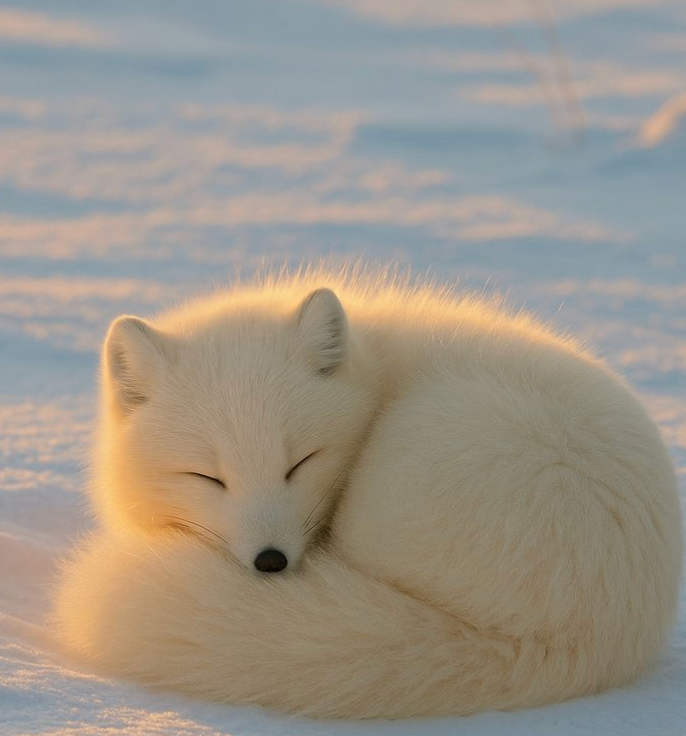
It is in this vast stillness that the Arctic fox rests — curled tightly into a perfect snowy sphere, nose tucked beneath its tail, fur shining white against the endless white of its world. It almost disappears, indistinguishable from the snow it lies upon. Only the faintest movement — the subtle rise and fall of its breath — reveals the life inside the softness.
If you stand far enough away, you might mistake it for a snowdrift.
If you stand close enough, you might feel something stir in your chest — a sense of awe for this tiny creature that survives, even thrives, in one of the harshest environments on Earth.
This fox is not merely resting.
It is embodying a miracle of adaptation: a creature sculpted by ice, refined by wind, and perfected by evolution.
And through the fox, we enter a story much larger than itself — the story of Arctic life, ancient knowledge, ecological interdependence, and a rapidly changing world.
Part I: The Stillness of the North — A Landscape of Quiet Power
A World Made of Light and Snow
The Arctic is not empty.
It is spacious.
A place where distance itself becomes a kind of sculpture.
Where sound travels for miles.
Where the sky dominates as much as the land.
In winter, light behaves differently here. It spreads sideways, not downward. It washes the world in gentle blues, pinks, and silvers. The sun does not blaze — it glows. You can stare directly at it without blinking.
Shadows stretch long and delicate across the snow, trembling in the wind.
The quiet is immense — not silence, exactly, but a stillness that feels alive:
- the soft hiss of windblown snow
- the dull thump of distant ice shifting
- the faint click of frost forming on exposed rock
- the occasional bark of a fox, echoing through empty valleys
Winter in the Arctic is not simply a season.
It is a presence — profound, demanding, sacred.

Life Hiding in the White
It would be easy to imagine the Arctic as barren, but beneath the snow, within its cracks, atop its ridges, life persists in forms both fragile and resilient.
Lemmings tunnel beneath the snowpack.
Ptarmigans shuffle across drifts, feathers puffed against the cold.
Wolves prowl the edges of the tundra.
Snowy owls perch motionless, yellow eyes scanning.
Polar bears roam the sea ice in search of seals.
Each creature embodies a different strategy for survival.
But none are as intimately woven into the Arctic’s fabric as the fox.
The Arctic fox does not merely live here — it belongs here.
Part II: The Arctic Fox — A Masterpiece of Cold Adaptation
A White Whisper Against the Snow
Curled into its winter posture, the Arctic fox appears perfectly round. There is logic in this shape — minimizing surface area reduces heat loss. Nothing extraneous sticks out: ears small and rounded, muzzle short, paws furred thickly.
Everything about its body speaks the language of survival.
Fur Like Winter Incarnate
The Arctic fox’s fur is its crown jewel — the warmest coat of any mammal its size. In winter, each strand becomes hollow, trapping air for insulation. The undercoat is unbelievably dense, while the guard hairs repel water and frost.
Its winter coat is so insulating that snow landing on it does not melt.
Come summer, the fox sheds this whiteness for a thinner, brown-gray coat that blends with tundra rock and shrub.
Two worlds.
Two identities.
One animal.
A Body Built for Cold
Arctic fox physiology reads like a checklist of cold-weather perfection:
- Short ears and muzzle: less surface area to freeze
- Thick tail (the alaðaq in many Indigenous languages): used as a blanket
- High body fat reserves: up to 50% of body weight in winter
- Countercurrent heat exchange in paws: warm blood flows to the toes, warmed again on the return up the leg, reducing heat loss
- Incredible metabolic efficiency: minimizing energy use during storms or extreme cold
A fox can withstand temperatures below –50°C.
It doesn’t just survive the cold.
It ignores it.
The Art of Disappearing
Camouflage is one of the fox’s greatest evolutionary advantages.
In winter:
snow white.
In summer:
stone gray or brown.
This transformation is timed to temperature and daylight, controlled by hormones responding to the changing Arctic sun.
In the endless white of winter, the fox becomes invisible.
It is the snow, watching you.
The Fox as Hunter — Listening to the Unseen
Arctic foxes are opportunists, scavengers, and skilled predators. Their primary prey is the lemming — a rodent whose population cycles shape fox reproduction.
But the way foxes hunt is almost magical.
They pause.
Head tilts.
Ears rotate like radar dishes.
Then — the pounce.
A high, arcing leap through the air, nose pointed downward, landing with pinpoint accuracy into hidden snow tunnels to catch a lemming below.
Scientists believe foxes use not only keen hearing but possibly Earth’s magnetic field to align attack angles. They can detect vibrations beneath snow, even hearing prey move under several feet of drifts.
They survive through finesse, not force — by listening to what snow tries to hide.
Seasonal Rhythms — The Pulse of Arctic Life
The fox’s entire life revolves around cycles of abundance and scarcity.
Spring
The sun returns. Snow melts. Foxes pair up and find dens — sometimes reusing dens centuries old. Pups are born, blind and helpless, in litters of up to 14.
Summer
The tundra blooms with wildflowers, insects, and birds. The fox hunts constantly to feed growing pups.
Autumn
Prey wanes. The coat thickens. Fat reserves build. The fox roams widely, caching food.
Winter
Darkness settles. Temperatures plunge. Food becomes scarce. Some foxes roam hundreds of kilometers — one famous individual traveled over 3,500 km from Norway to Canada across sea ice.
The fox is a traveler of unimaginable endurance.
Part III: Other Masters of Cold — Arctic Species Shaped by Ice
The Arctic fox is just one thread in a vast, tightly woven web of life. Each organism — from moss to muskox to microscopic algae — contributes to the survival of others.
Polar Bears — Lords of the Ice
Polar bears depend on the sea ice to hunt seals. Without ice, they starve.
Adaptations include:
- hollow fur for insulation
- black skin to absorb heat
- a sense of smell so powerful they can detect seals under snow
- massive padded paws for traction
The bear and the fox often interact: foxes trail bears, scavenging leftovers. It is a relationship built on timing and patience.
Muskoxen — Ancient Survivors
Shaggy, prehistoric-looking, muskoxen withstand brutal cold through:
- qiviut (the warmest wool in the world)
- herd defense circles
- slow, energy-efficient movement
They carve trails through deep snow, benefiting other species.
Snowy Owls — Ghosts of the Tundra
White feathers, golden eyes, silent wings.
They follow lemming booms just as foxes do.
Their migration is unpredictable, driven by prey cycles.
Lemmings — The Beating Heart of the Tundra
Tiny but mighty.
Their population booms fuel the breeding success of foxes, owls, stoats, and other predators. When lemmings crash, the entire ecosystem feels it.
Ringed Seals, Narwhals, Belugas
Beneath the ice:
- seals birth pups in snow lairs
- belugas navigate using sophisticated echolocation
- narwhals dive astonishing depths, their tusks sensors of water chemistry
Every Arctic creature is an answer to a specific ecological riddle posed by the cold.
Plants That Thrive in Cold
The tundra hosts:
- dwarf shrubs
- mosses and lichens
- cotton grass
- Arctic poppies that track the sun
They grow low to the ground, conserving heat and resisting frost damage.
Life in the Arctic is slow, resilient, and exquisitely adapted.
Part IV: Ecology of the Far North — Interdependence in a Land of Extremes
Food Webs in a Place of Scarcity
The Arctic food web is simple compared to rainforests — but incredibly sensitive.
Energy flows from:
- sunlight → tundra plants
- plants → herbivores (lemmings, caribou)
- herbivores → predators (foxes, wolves, owls)
- predators → scavengers (foxes again, ravens, bears)
Because resources are few, every species matters. Remove one, and the web frays.
Extreme Seasons — A Life Split in Two
The Arctic doesn’t have four seasons.
It has two extremes:
Endless Light
Summer brings 24-hour sun — a frenzy of activity.
Endless Dark
Winter brings months of darkness — a world defined by moonlight and aurora.
Animals synchronize their lives to these periods.
Breeding. Migration. Hunting. Movement.
Everything is tied to light.
Permafrost — The Ground That Never Sleeps
Permafrost is permanently frozen soil that underlies much of the Arctic. It stores:
- ancient carbon
- preserved plant material
- ice crystals
- microbial life
As it thaws due to warming, it releases methane and carbon dioxide — amplifying climate change.
The ground itself becomes unstable: roads buckle, lakes drain, coastlines collapse.
The Arctic fox’s world is literally melting.
Part V: Indigenous Knowledge — The Arctic as Home, Teacher, Ancestor
For thousands of years, Arctic Indigenous peoples — Inuit, Sámi, Yupik, Chukchi, and others — have understood the rhythms of this land more deeply than any scientist.
The Fox in Indigenous Culture
To many communities, the Arctic fox is:
- a trickster
- a survivor
- a messenger
- a teacher of adaptability
Fox tracks in the snow reveal messages about weather, prey movement, and seasonal change.
Ecological Knowledge Passed Through Generations
Indigenous knowledge (IQ, Inuit Qaujimajatuqangit) teaches:
- how sea ice forms and breaks
- how winds signal weather shifts
- migration patterns of caribou
- behavior of seals and fish
- respectful, sustainable harvest practices
This knowledge is observational, relational, lived — gathered over centuries of coexistence with the Arctic’s cycles.
Harmony with the Land
Indigenous worldviews emphasize:
- taking only what is needed
- honoring animals
- sharing resources
- maintaining balance
The Arctic fox, small as it is, plays a symbolic role in this interconnected worldview.
Part VI: A Changing World — Climate Science and the Unraveling North
The Arctic is warming four times faster than the global average.
And everything is changing.
Melting Sea Ice
Sea ice is habitat for:
- seals
- polar bears
- walrus
- plankton communities beneath the ice
Less ice means:
- harder hunting
- fewer safe denning sites
- increased mortality
- disrupted food webs
Arctic foxes that rely on sea ice to reach food sources face starvation.
Shrinking Snowpack
Foxes depend on snow for:
- hunting lemmings
- thermal insulation
- camouflage
Without snow:
- predation becomes harder
- pups are more exposed
- energy expenditure skyrockets
Shifting Species Ranges
The red fox, larger and more aggressive, is moving north as temperatures warm. It competes with and sometimes kills Arctic foxes.
Unpredictable Lemming Cycles
Lemming populations rely on stable winter snowpack.
Warmer winters = crusty ice layers instead of soft insulation = fewer lemmings.
Without lemmings, fox reproduction plummets.
Coastal Erosion and Permafrost Thaw
Fox dens — sometimes used for centuries — collapse as permafrost melts.
Entire sections of coastline are washing into the sea.
The Arctic as Climate Indicator
What happens here does not stay here.
Arctic warming affects:
- global weather patterns
- sea levels
- ocean circulation
- atmospheric currents
The Arctic fox’s shrinking world foreshadows our own.
Part VII: Hope in a Fragile Landscape — Conservation and Action
Despite the immense challenges, hope persists in science, community leadership, and global action.
Indigenous-Led Conservation
Projects centered around Indigenous governance are revitalizing Arctic stewardship. Examples include:
- community-based wildlife monitoring
- co-management of protected areas
- traditional harvest regulations
- youth land-based education
- renewable energy initiatives
Protected Areas and Wildlife Corridors
Expanding preserves ensures:
- migration routes
- denning habitats
- stable prey populations
Climate Action
Reducing emissions is the single most important action for Arctic species.
Every degree of warming avoided saves ecosystems.
Research and Monitoring
Tracking fox movements, studying ice thickness, monitoring den stability — all provide data to guide policy.
Reducing Local Pressures
- controlling red fox encroachment
- protecting den sites
- reducing industrial disturbance
The Arctic fox does not need the world to be perfect.
It needs the world to stop unraveling so quickly.
Part VIII: Returning to the Fox — Stillness, Resilience, and the Poetry of Survival
The Arctic fox is still curled in the snow.
Its fur glows faintly in the soft winter light, each strand shimmering with frost. The air around it is completely still, holding a silence so deep you can hear your own heartbeat.
This creature, so small and delicate, holds within it a lineage older than ice. It is the result of countless winters survived, countless storms endured, countless leaps made into unseen snow.
It is resilience wrapped in softness.
Survival disguised as beauty.
A fragment of the Arctic’s soul.
And yet —
This world, this fox, this cold brilliance — all are changing faster than they can adapt.
When you look at this resting fox, you are not just seeing an animal.
You are seeing an entire climate story curled into a single living being.
A story about endurance.
A story about fragility.
A story about responsibility.
The Arctic fox sleeps, trusting the cold to protect it.
But the cold is leaving.
Conclusion: What the Arctic Fox Teaches Us About Our World and Ourselves
The fox breathes softly beneath its tail.
The sky shifts pale gold.
Snow drifts like feathers.
And the Arctic remains — beautiful, harsh, ancient, trembling.
This place teaches us:
- that life can thrive in places we imagine lifeless
- that beauty and brutality can coexist
- that adaptation has limits
- that climate is not an abstract concept, but a living world unraveling
To protect the Arctic fox is to protect:
- sea ice
- permafrost
- tundra ecosystems
- Indigenous ways of life
- global climate stability
- the idea that wilderness still has a place on Earth
Because when a creature as perfectly adapted as the Arctic fox begins to struggle, it means the world is changing in ways nothing can ignore.
And yet—
The fox itself offers a lesson:
Be alert.
Be adaptable.
Find warmth in community.
Respect cycles.
Tread lightly.
Rest when needed.
Move when the moment calls.
The Arctic fox is a teacher, a symbol, a fragile miracle.
And if we listen closely —
if we protect the snow it sleeps upon,
the ice it hunts upon,
and the world it depends upon —
then perhaps the Arctic will continue whispering its ancient, icy stories for generations yet to come.