
The savanna exhales at dusk.
Heat rises in wavering ghost-like ribbons from the earth, dissolving into a sky turning slowly from copper to amber to deepening violet. The wind softens, brushing through tall, sun-burnished grasses in gentle waves that shimmer as if lit from within. The dust of the day hangs in the air, glowing like embers in the slanting light. Insects hum — a layered chorus of crickets, cicadas, and night-blooming voices — each note folding into the next. A lone acacia tree stands against the horizon, its silhouette sharp and unmistakable.
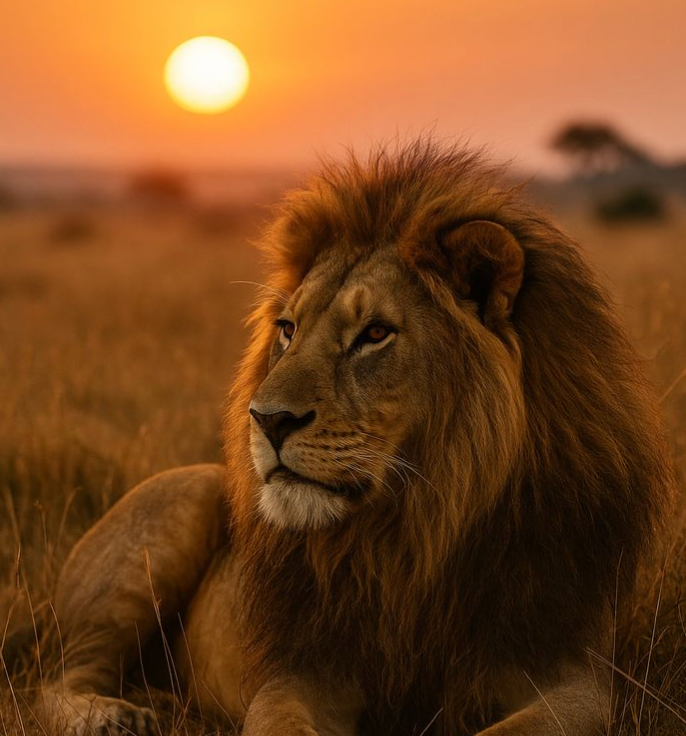
Somewhere beyond the reach of the fading sun, a lion lies half-hidden in the grass.
Golden on gold, he is nearly invisible — just the slow rise and fall of his chest betraying his presence. His mane catches the last of the day’s warmth, turning briefly into a halo of fire. Amber eyes blink lazily, reflecting both exhaustion and something ancient: a calm confidence earned through generations of survival.
The air changes around him.
The day’s heat loosens its grip.
Shadows lengthen.
Senses sharpen.
Across the plains, antelope lift their heads, ears swiveling like satellite dishes. Zebras tighten their groups. Warthogs hurry toward burrows. A distant herd of wildebeest shifts uneasily, sensing the subtle rearrangement of the evening: the slow, inevitable shift from light to dark, from grazing to vigilance.
For the lion, dusk is not an ending.
It is an opening.
This is where our story begins:
in the golden hush before night,
with a lion stretched across the savanna like a living relic of fire and muscle,
and a landscape preparing for the night’s ancient dance of hunger, danger, movement, and life.
But this is not only a story about lions.
It is a story about an entire ecosystem — one of Earth’s most iconic, complex, and vulnerable theatres of life.
And so we follow him — the lion in the grass — into the ecology, science, spirit, and struggle of the African savanna.
Part I: The Kingdom of Dusk — The Sensory Soul of the Savanna
The Atmosphere Shifts
In the minutes after sunset, the savanna becomes a symphony of transitions:
- Light softens into muted violet.
- Shadows stretch into delicate crosshatch patterns.
- The wind cools, carrying the dry mineral scent of soil.
- Day animals settle, their silhouettes fading into the grass.
- Nocturnal creatures stir, testing the air for opportunity.
Dust motes glint like tiny stars drifting upward. The horizon blurs, blending sky and earth into a soft band of gold. This is the magic hour, the threshold between safety and risk.
Predators know this moment well.
So do their prey.
The Grass — A Sea of Movement
Savanna grass is never still. Even in silence, it sways, undulates, curls, shivers — a restless golden sea hiding thousands of tiny dramas.
Within its expanse:
- mice scurry
- insects dance
- lizards warm themselves
- snakes glide
- antelope graze
- lion cubs hide and pounce
The grass is both cradle and battlefield. It shelters, feeds, obscures, and reveals. In the savanna, grass is not background; it is lifeblood.
The Lion’s Stillness
Our lion remains motionless, listening to a soundscape that humans rarely perceive: the faint thrum of hooves miles away, the distant cough of another lion, the approach of a black-backed jackal, the subtle shift of a nearby hartebeest.
To watch a lion at dusk is to witness a creature completely, utterly attuned to its world — not through thought, but through instinct refined across millennia.
The savanna belongs to no single species.
But lions move through it as if carved from its very earth.
Part II: The Lion — Power, Strategy, and the Biology of a Predator
The Anatomy of Strength
A lion’s body is a masterpiece of predatory design:
- Powerful shoulders shaped for grappling large prey.
- Massive forelimbs lined with strong flexor muscles.
- Retractable claws that remain sharp even after countless hunts.
- A jaw structure capable of delivering crushing force.
- Forward-facing eyes optimized for depth perception.
- Whiskers tuned to sense air disturbances.
Their hearts and lungs are built for brief, explosive power — not endurance. Lions are sprinters, ambush experts, masters of short bursts.
This is why the moment of attack is everything.
And why stillness — the gathering of potential energy — is a crucial part of their strategy.
Pride Structure — The Family Behind the Hunter
Unlike most big cats, lions live in groups called prides, forming complex social structures that revolve around:
- Adult lionesses — the core of the pride, often related.
- Cubs — raised cooperatively by the females.
- Males — typically brothers or cousins, forming coalitions.
Each lion serves a role:
Lionesses — The Engine of the Pride
They hunt together, defend territory, raise cubs communally, and maintain the social fabric.
Coalition Males — The Guardians
They protect pride lands, fend off intruders, and sire cubs.
Their reign lasts on average 2–3 years before a rival coalition challenges them.
When they fall, new males may kill existing cubs — a brutal evolutionary tactic that pushes females back into estrus.
Cubs — The Future
They learn through:
- play
- observation
- imitation
- feedback from the pride
Every pounce on a sibling is practice for adulthood.
Communication — The Lion’s Language
Lions communicate using:
Roars
The loudest of any big cat, carrying up to 8 kilometres.
Roars assert territory, maintain pride cohesion, and warn rivals.
Scent Marking
Territory boundaries painted with urine and gland secretions.
Vocalizations
Chuffs, growls, grunts, meows, moans — each with nuanced meaning.
Body Language
Ear angles, tail twitches, eye contact, posture.
A pride is held together by these constant messages, most of them subtle, many of them physical.
Hunting — The Strategy of Shadows
Lions typically hunt under the cover of night, using:
- Ambush from tall grass
- Group coordination (often females working together)
- Flanking and cutting off escape routes
- Explosive bursts of speed
Common prey includes:
- wildebeest
- zebra
- buffalo
- impala
- warthog
- giraffe (rare but possible)
The savanna is not a static scene; it is a battlefield of strategy and adaptation.
And yet, lions succeed only about 20–30% of the time.
Predation is difficult, energy-expensive, risky.
But nature’s designs allow no other path.
Part III: A Wider World — Life and Balance in the Savanna
Prey Species — The Great Travelers
The savanna is home to Earth’s greatest migrations:
Wildebeest
Millions move in circular patterns following rain and fresh grass — a migration so huge it shapes the behavior of predators, scavengers, and even plant communities.
Zebra
Often traveling with wildebeest, using complementary grazing styles that benefit both species.
Gazelles, impala, kudu
Each with its own strategy of vigilance, speed, grouping, or camouflage.
These herbivores form the foundation of the savanna food web.
The Role of Fire
Fire shapes the savanna.
It clears old growth, stimulates new shoots, recycles nutrients, and prevents forests from overtaking grasslands.
Many species rely on it:
- Plants evolved thick bark and deep roots.
- Birds like drongos and kites hunt insects fleeing from flames.
- Ungulates feed on tender regrowth days later.
Fire is not destruction; it is renewal.
Climate — The Keeper of Rhythms
Savannas depend on:
- seasonal rainfall
- rhythmic drought
- predictable wet periods
- scattered water holes
These patterns govern everything: migrations, reproduction, vegetation, predator success.
Climate change is disrupting this choreography — shortening rains, intensifying droughts, stressing herbivores and, in turn, the predators who depend on them.
The Web of Balance
Remove one piece, and the entire system shifts.
Lions regulate herbivore populations.
Herbivores regulate vegetation.
Vegetation regulates fire and soil.
Scavengers (hyenas, vultures) recycle nutrients.
Everything depends on everything else.
This is the rule of the savanna — one of Earth’s most interconnected ecosystems.
Part IV: The Lion’s Fate — Conflict, Loss, and the Fragile Future
Human–Wildlife Conflict
Lions range widely, but human expansion has shrunk their habitat and brought them into frequent conflict with livestock owners.
When lions kill cattle or goats, retaliation can be swift:
- spears
- poison
- traps
Entire prides can disappear overnight.
Habitat Loss and Fragmentation
Fences, farms, settlements, and roads carve the continent into pieces.
Lions need connected landscapes.
Isolated populations collapse through:
- inbreeding
- reduced prey
- territorial compression
- increased conflict
Once, lions lived across Europe, the Middle East, and much of Asia.
Today, they occupy only 8% of their historic range.

Poaching and the Bone Trade
Even protected lions face pressure from:
- trophy hunting (in some regions)
- illegal trade, especially bones used as substitutes for tiger parts
The ethics are complex, the consequences severe.
Decline by the Numbers
A century ago, there were hundreds of thousands of lions.
Now?
Roughly 20,000 remain in the wild.
They are classified as Vulnerable, with some regional populations critically endangered.
Their roar is becoming a rarer sound.
Part V: Hope on the Horizon — Conservation and Coexistence
Despite the challenges, lion conservation is not a story of defeat.
It is a story of transformation.
Community-Based Conservation
Projects that empower local communities are changing everything:
- compensation for livestock losses
- lion-proof corrals
- eco-tourism funds returning to villages
- community scouts trained in wildlife protection
When local people benefit from lions, lions survive.
Landscape Connectivity
Creating wildlife corridors across countries — such as the Kavango-Zambezi Transfrontier Conservation Area — allows lions to roam, breed, disperse, and maintain genetic diversity.
Technology in Conservation
Tools now include:
- GPS collars
- satellite tracking
- camera traps
- drones
These help researchers monitor lion movements and protect critical areas.
Rewilding and Protected Areas
Many parks in Africa are being revitalized through:
- anti-poaching units
- habitat restoration
- reintroduction of prey
- fencing that allows controlled movement
With proper management, lion numbers can rebound.
Changing Perception
The most powerful conservation tool is cultural:
changing how humans view predators.
Lions are not enemies.
They are engineers of ecosystems.
Symbols of the wild.
Indicators of Africa’s ecological health.
When we honor lions, we honor the landscapes that created them.
Part VI: Returning to the Lion at Dusk
The sun has slipped below the horizon.
The sky now glows with residual light — a dim blue fading into the vast dark. The grasses whisper as a breeze stirs them. A hyena whoops in the distance. Insects buzz louder. Night takes its place on the stage.
The lion rises.
Not quickly — with the slow, deliberate stretch of an animal confident in its strength. He yawns, showing a jaw built for dominance and survival. His muscles bunch beneath his fur. His tail swishes once, twice.
He smells the air.
Listens for movement.
Feels the cooling earth beneath his paws.
And then he steps forward — emerging fully into the world of moonlight and instinct.
Tonight, he may patrol his territory.
He may join his pride.
He may hunt, or roar, or simply walk the perimeter of his domain.
But whatever he does, he will be fulfilling a role millions of years in the making — the role of a keystone predator, a sculptor of ecosystems, a symbol of endurance and majesty.
The lion is strength.
But the lion is also vulnerability.
He depends on grasslands that depend on rain that depend on climate that depends on us.
He belongs to Earth’s oldest rhythm —
a rhythm we must learn to protect.
Conclusion: Why Lions Matter, and Why Their Future Is Our Responsibility
To watch a lion lying in golden grass beneath a setting sun is to witness the soul of the savanna.
It is to feel the weight of evolution, the beauty of balance, the fragility of wildness.
Lions are not just animals; they are:
- apex regulators
- cultural icons
- ecological engineers
- storytellers of the plains
- beings whose presence holds together entire worlds
When they decline, the savanna falters.
When they flourish, everything rises with them.
Protecting lions is not only about protecting a species.
It is about protecting migration routes, grasslands, prey herds, forests, rivers, and the people who live alongside them.
It is about honoring the wild parts of our planet that remind us what life looks like when left to its own wisdom.
And it is about understanding that our future is bound to theirs —
that in saving lions, we save something sacred within ourselves.
The lion steps into the night.
The savanna hums around him.
The stars awaken above.
And the grass whispers its ancient promise:
As long as the lions walk, the world still holds wildness.
As long as the wild remains, hope remains too.