I. The Murmur Beneath the Trees
It begins as a whisper.
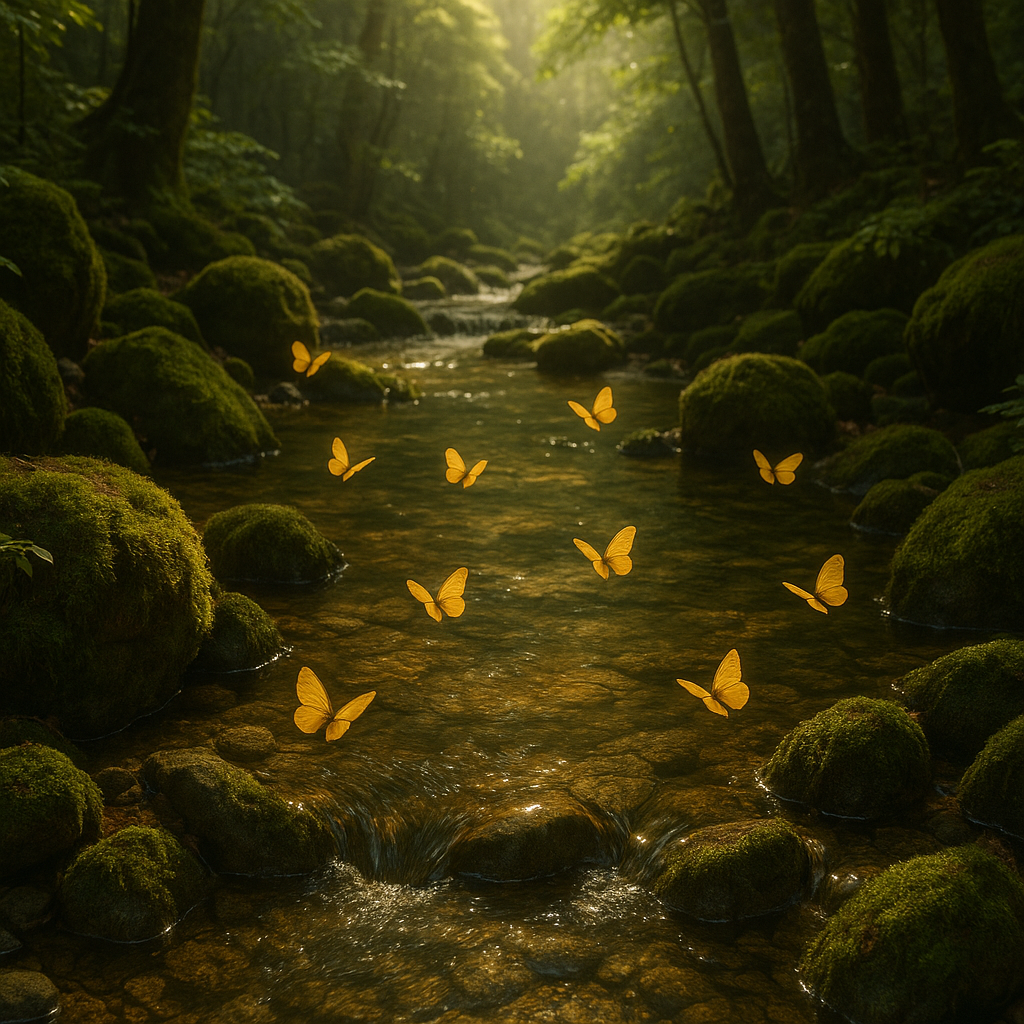
A trickle of water, slipping between moss-covered stones, tracing a silver ribbon through the forest floor. Sunlight breaks through the canopy in shifting gold, glinting off ripples like scattered coins. The air smells of damp earth and pine resin, sweet and clean.
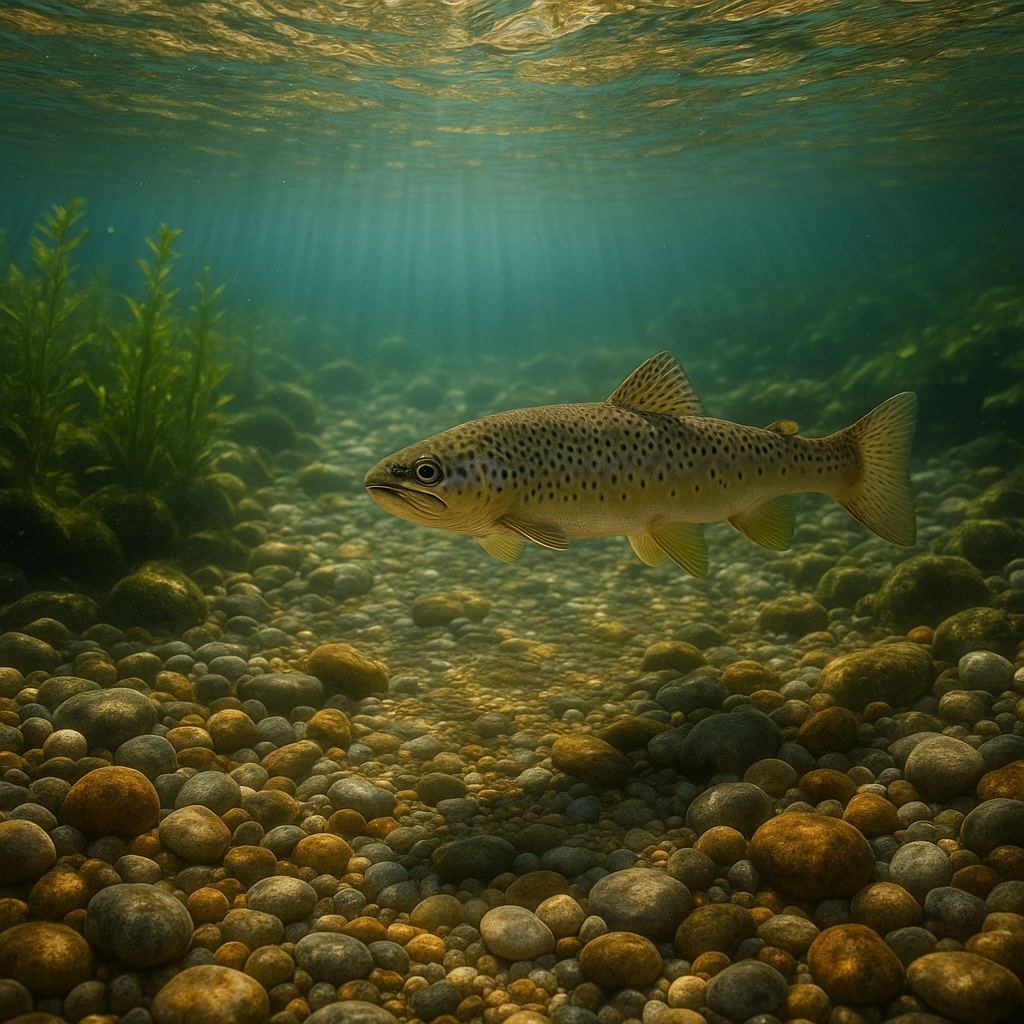
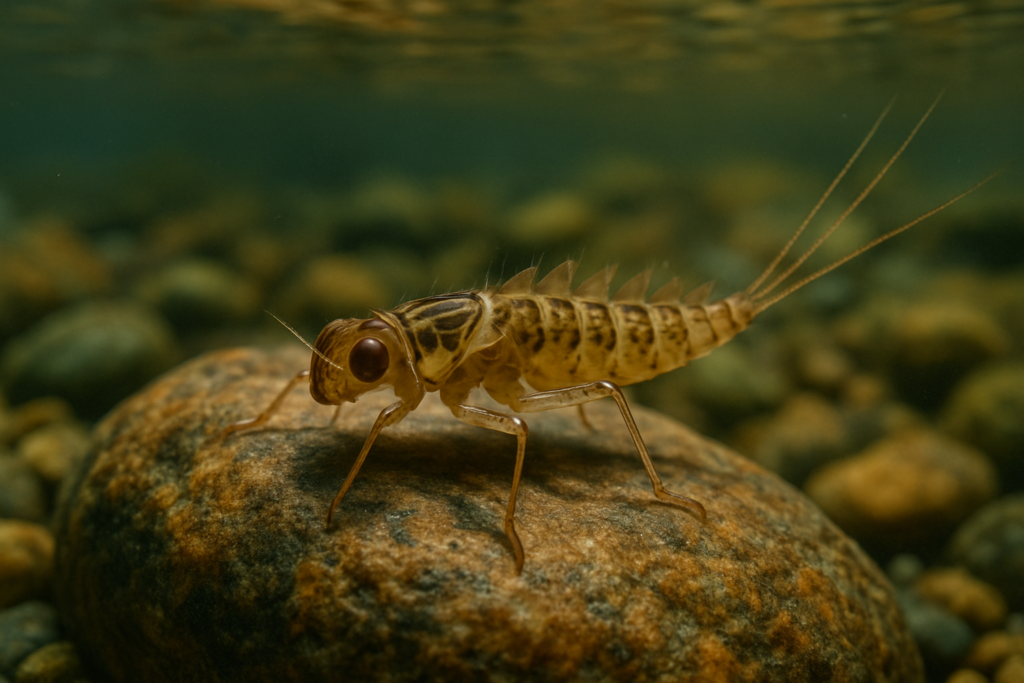
Golden butterflies hover over the water’s surface, their wings reflecting the green of the leaves. A dragonfly lands on a fern frond, its transparent wings catching the light like glass. Beneath the surface, the world moves quietly — fish dart through shadows, and mayfly larvae cling to smooth pebbles, swaying in the current.
The sound of the stream is ancient — older than language, older than memory. It is the forest’s heartbeat, constant and clear. Every bend, every pool, every cascade carries stories written in movement and sound. This is the voice of water — patient, tireless, eternal.
To follow a stream through the forest is to follow life itself. From its hidden source to its merging with the great rivers and oceans, the stream nourishes everything it touches. Its journey mirrors our own — from stillness to motion, from solitude to connection.
Here, in this living thread of water, lies the secret heart of the forest.
II. The Arteries of the Earth — The Role of Freshwater Ecosystems
Forests and water are bound together like breath and body. Neither can exist without the other.
Freshwater ecosystems — rivers, creeks, springs, wetlands, and lakes — form the circulatory system of the planet. They carry nutrients, regulate temperature, and sustain both terrestrial and aquatic life. In the same way that veins deliver oxygen to cells, streams deliver energy and minerals throughout the landscape.
When rain falls upon leaves, some is absorbed by roots, some evaporates into the air, but much of it trickles downward, carving small channels that grow into rivulets and streams. These waters gather sediments, seeds, and organic matter, redistributing them as they flow. Every twist and turn is shaped by geology, but softened by biology — roots stabilizing banks, moss filtering debris, fallen logs redirecting flow.
A single healthy stream supports hundreds of species — from microscopic algae to amphibians, mammals, and birds. Insects breed in its shallows; deer and foxes drink at its edge; owls and kingfishers hunt its inhabitants.
Without freshwater, the forest’s lushness would fade into silence. Streams are not just features of the landscape — they are the landscape’s lifeblood.
III. The Hydrological Symphony — How Water Moves Through the World
The water flowing through the forest today is not new. It is ancient — the same water that once filled the primordial seas, that rose as vapor from coral lagoons, that froze in glaciers and fell again as rain.
This endless recycling is known as the hydrological cycle, nature’s grand choreography of evaporation, condensation, precipitation, and flow.
1. Evaporation and Transpiration
As sunlight warms the surface of oceans, lakes, and leaves, water molecules escape into the atmosphere as vapor. Trees play an extraordinary role in this — through transpiration, they release moisture from their leaves, creating invisible plumes that rise to form clouds. A mature forest can transpire thousands of liters of water each day, influencing local and even global weather patterns.
2. Condensation and Precipitation
In the sky, vapor cools and condenses into droplets, forming clouds that travel across the land. When these droplets merge and grow heavy, they fall as rain, replenishing rivers and groundwater. Forests act as natural sponges, capturing rainfall in their canopy and soil, slowing its descent, and preventing erosion.
3. Infiltration and Flow
Once on the ground, water follows gravity’s call. Some seeps into the soil, feeding underground aquifers; some runs overland, forming streams that join into rivers. This flow, shaped by terrain and time, eventually returns to the sea — completing the cycle, only to begin again.
Through this eternal dance, water connects all ecosystems — from mountaintop glaciers to rainforest pools. It is the planet’s quiet circulatory system, uniting every form of life in a single, flowing story.
IV. The Hidden Web — Life Within the Stream
Beneath the glassy surface of a stream lies a bustling metropolis. Stones and silt conceal creatures both delicate and fierce, each playing a role in the invisible machinery of life.
1. Macroinvertebrates — The Stream’s Engineers
The smallest architects of stream health are macroinvertebrates — insects, worms, snails, and crustaceans visible to the naked eye. Mayflies, stoneflies, and caddisflies spend most of their lives underwater, clinging to rocks and feeding on organic debris. When they mature, they emerge into the air, becoming food for fish, frogs, and birds.
Because they are sensitive to pollution, their presence is a measure of water quality. A stream teeming with diverse macroinvertebrates is a sign of purity; their absence is a warning.
2. Amphibians — The Shape-shifters
Amphibians bridge water and land, embodying transition. Frogs, salamanders, and newts lay eggs in still pools, their larvae breathing through gills before transforming into air-breathing adults. Their dual existence makes them indicators of environmental balance — they depend on both clean water and intact forests.
3. Fish — The Flowing Lineage
Fish are the most visible inhabitants of streams. Trout, salmon, and minnows glide between riffles and pools, feeding on insects and smaller prey. Some, like the salmon, undertake epic migrations, returning from the sea to the exact stream where they were born — guided by scent and magnetic fields.
Each return brings nutrients from the ocean, enriching inland forests as bears and eagles feast upon their carcasses. Even in death, salmon feed the trees — their nitrogen traced in the rings of cedars and pines miles from the coast.
Within every stream, from headwaters to mouth, this network of life hums in balance — energy cycling endlessly between sunlight, water, and living form.
V. The Stream as a Service — Nature’s Work Made Invisible
Though small, streams perform monumental labor. Scientists call these benefits ecosystem services — processes that sustain both biodiversity and humanity, often unnoticed yet irreplaceable.
1. Natural Filtration
As water flows over gravel, roots, and moss, sediments settle out and pollutants are filtered. Microbes in the soil break down organic waste, transforming contaminants into harmless compounds. A single meter of healthy streambank can purify thousands of liters of water each day — far more efficiently than any human-made plant.
2. Carbon Storage
Wetlands and riparian soils store vast amounts of carbon, trapping decaying material in oxygen-poor conditions that slow decomposition. This makes them powerful buffers against climate change. When drained or destroyed, however, they release that carbon back into the atmosphere, amplifying warming.
3. Flood Control and Erosion Prevention
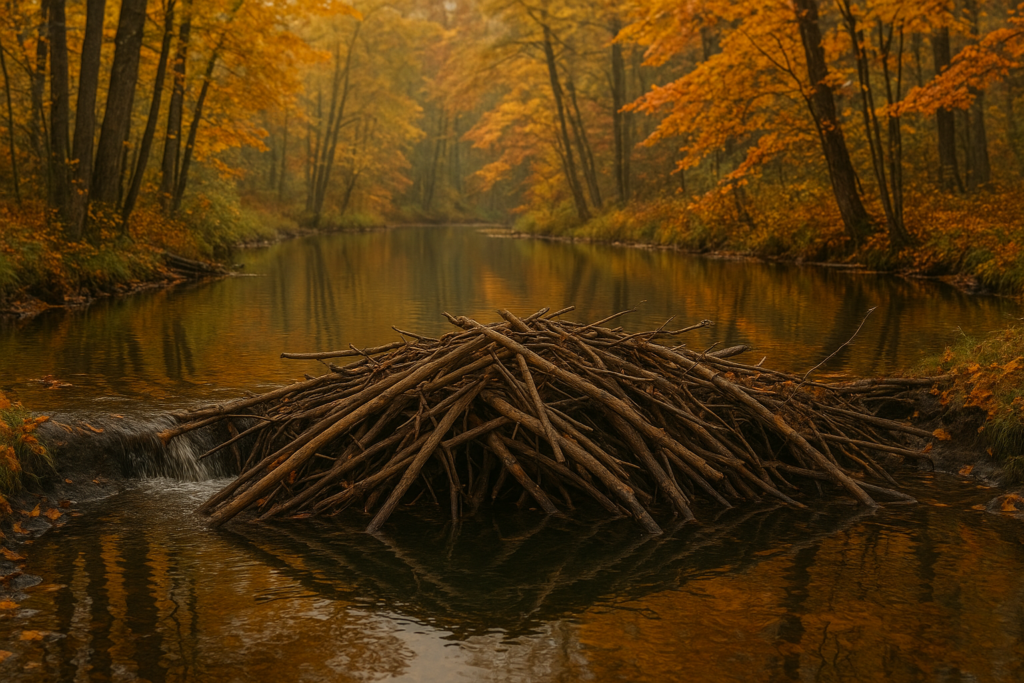
Vegetation along streams acts as a living barrier, absorbing floodwaters and stabilizing soil. Forest roots anchor riverbanks; fallen logs and beaver dams slow runoff. In natural systems, floods are gentle, replenishing events rather than disasters. It is when these buffers are lost that floods turn destructive.
4. Habitat Creation
Streams carve diversity into the land. Deep pools, gravel bars, and shaded bends create microhabitats for countless species. The combination of movement and stillness ensures variety — and variety sustains resilience.
What we call a “creek” or “brook” is not a line on a map, but a living organism — filtering, feeding, cooling, and shaping the forest it flows through.
VI. Masters of the Current — Adaptations to Flowing Life
Life in a stream is a study in adaptation. Every inhabitant has evolved to survive in motion.
1. Clingers and Crawlers
Mayfly nymphs have flattened bodies and hooked claws to resist strong currents. Caddisfly larvae build tiny armored cases from sand and leaves, anchoring themselves to rocks. Blackfly larvae attach with silk threads, filtering food particles from passing water.
2. Swimmers and Sliders
Fish possess streamlined bodies and powerful tails for efficient swimming. The rainbow trout’s muscular frame allows it to hold position in fast-flowing water, while darters rely on short bursts of motion, darting between pebbles where the current slackens.
3. Amphibious Architects
Beavers are the forest’s engineers, transforming streams into ponds with dams of sticks and mud. These ponds create habitat for countless species — ducks, turtles, insects — while recharging groundwater and trapping sediment. Beavers increase biodiversity simply by being themselves.
4. Plants of the Flow
Aquatic plants like waterweed and river moss bend gracefully with the current, reducing drag. Their flexible stems and thin leaves maximize surface area for photosynthesis while preventing damage during floods. Even here, light meets life — filtered through the shimmer of moving water.
Adaptation is not just survival — it is harmony. Each species, in its form and function, fits perfectly into the rhythm of the stream.
VII. The Fragile Balance — Threats to Freshwater Ecosystems
Despite their beauty and importance, freshwater systems are among the most endangered ecosystems on Earth. Less than 1% of the planet’s water is available as fresh, flowing surface water — and yet it sustains nearly half of all known species.

1. Pollution
Industrial runoff, agricultural fertilizers, and sewage introduce chemicals that choke streams. Excess nutrients trigger algal blooms, depleting oxygen and killing aquatic life. Heavy metals accumulate in sediments, poisoning fish and insects alike.
2. Deforestation and Erosion
When forests are cleared, soil loses its stability. Rain washes sediment into streams, smothering gravel beds where fish spawn and insects live. Without shade, water temperatures rise, stressing species adapted to cool conditions.
3. Dams and Diversions
Dams fragment rivers, blocking fish migrations and altering natural flow regimes. Water diverted for agriculture or cities leaves streams dry, silencing their once-constant music.
4. Climate Change
Rising temperatures and shifting rainfall patterns threaten the very foundation of the hydrological cycle. Glaciers — the sources of many great rivers — are melting. Droughts intensify, reducing flow, while storms grow more severe, causing floods and erosion.
Each of these pressures adds dissonance to the stream’s once-harmonious song. The whisper becomes a gasp.
VIII. Voices of Resilience — Species That Endure
Yet even in the face of change, freshwater life displays remarkable resilience.
1. The Desert Pupfish
In North America’s arid deserts, the tiny Devils Hole pupfish survives in a single limestone pool barely the size of a living room. Temperatures soar, oxygen is scarce — yet this fish endures, evolving in isolation for thousands of years. It is the rarest fish on Earth, a living testament to persistence.
2. The Axolotl — The Eternal Youth
Native to the highland lakes of Mexico, the axolotl remains in its juvenile form throughout life, retaining gills and an aquatic existence even as an adult. Revered by the Aztecs as a symbol of transformation, it is now critically endangered — but captive breeding offers hope.
3. The Freshwater Pearl Mussel
This unassuming mollusk filters up to 50 liters of water a day, cleaning entire stream systems. Its larvae hitch rides on fish gills, dispersing upstream to new habitats. In clear, unpolluted waters, their shells shine with subtle iridescence — a hidden jewel of the forest stream.
Each species tells a story of adaptation and endurance — but also of fragility. Their survival depends on our willingness to protect the waters that sustain them.
IX. The Return of the Stream — Stories of Restoration
Amid loss, there are also stories of hope — of rivers reborn, of water returned to song.
1. Rewilding Rivers
In Europe and North America, communities are dismantling obsolete dams, freeing rivers that have been silent for centuries. In the United States, the removal of the Elwha Dam in Washington State restored salmon runs to the Olympic Peninsula for the first time in 100 years. The forest responded — bears returned, eagles nested, vegetation flourished.
Across Europe, “rewilding” projects reintroduce beavers to degraded catchments. Their dams slow erosion, purify water, and create complex wetland mosaics. What engineers once viewed as nuisances are now recognized as allies.
2. Protecting Wetlands
Wetlands act as the planet’s kidneys, filtering impurities and buffering floods. Yet they have been drained faster than any other ecosystem. In recent years, international efforts such as the Ramsar Convention have safeguarded millions of hectares of wetlands worldwide, recognizing their role in climate resilience.
3. Urban Streams
Even cities are rediscovering their waterways. Projects like Seoul’s Cheonggyecheon Restoration transformed a buried river into a thriving green corridor, cooling the city and attracting wildlife. London, Melbourne, and Singapore are following suit — proving that urban life and natural flow need not be enemies.
Restoration is not merely ecological — it is emotional. It reconnects people with the elemental rhythm of water, reminding us that healing the land also heals the soul.
X. The Human Connection — Why Water Matters
Water is more than chemistry. It is memory, motion, and meaning.
Civilizations have always formed beside rivers — the Nile, the Ganges, the Amazon. Cultures have revered springs as sacred, attributing healing powers to their clarity. Even today, our rituals — from baptism to rain dances — echo humanity’s deep spiritual bond with water.
We are, quite literally, made of it. Every cell in our bodies carries the same molecules that once flowed through ancient streams. The rhythm of our pulse mirrors the rhythm of the current. To protect water is to protect ourselves.
When we pollute or dam or drain, we forget that water is not ours to command — it is ours to share. Its purity is the measure of our wisdom.
XI. A Call to Care — Guardians of the Flow
What can we do, as individuals, to honor the whispers of water?
- Conserve and respect water — use only what you need, and value it as the sacred resource it is.
- Plant native vegetation near waterways to prevent erosion and create habitat.
- Avoid pollutants and plastics, which often end up in rivers.
- Support watershed organizations and community cleanup efforts.
- Advocate for wetland protection and sustainable water management.
Even small acts — cleaning a streambank, installing a rain garden, choosing eco-friendly products — ripple outward. Each gesture becomes part of a larger current of restoration.
The health of our streams is inseparable from the health of our planet. And the health of our planet is inseparable from our own.
XII. Epilogue — Listening to the Stream
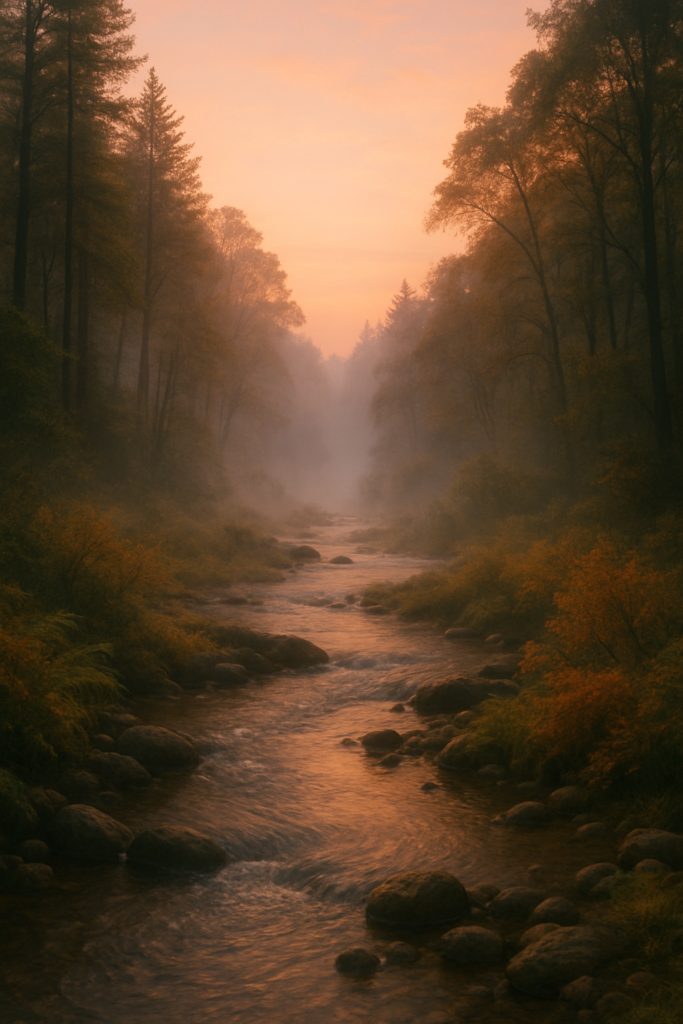
As twilight falls, the forest grows still. Mist rises from the water, turning the stream to silver. Somewhere, a frog calls. The air cools, scented with rain and moss.
You kneel by the bank, fingers brushing the cold current. It moves endlessly forward, carrying leaves, reflections, and the memory of every cloud. The butterflies have gone, the dragonfly sleeps — yet the whisper continues.
The forest drinks. The soil breathes. The water flows.
And in that flow, everything is connected — root to river, cloud to leaf, you to the world.
If you listen closely, you can still hear the ancient promise it carries:
that life, like water, always finds a way to return.