
Introduction
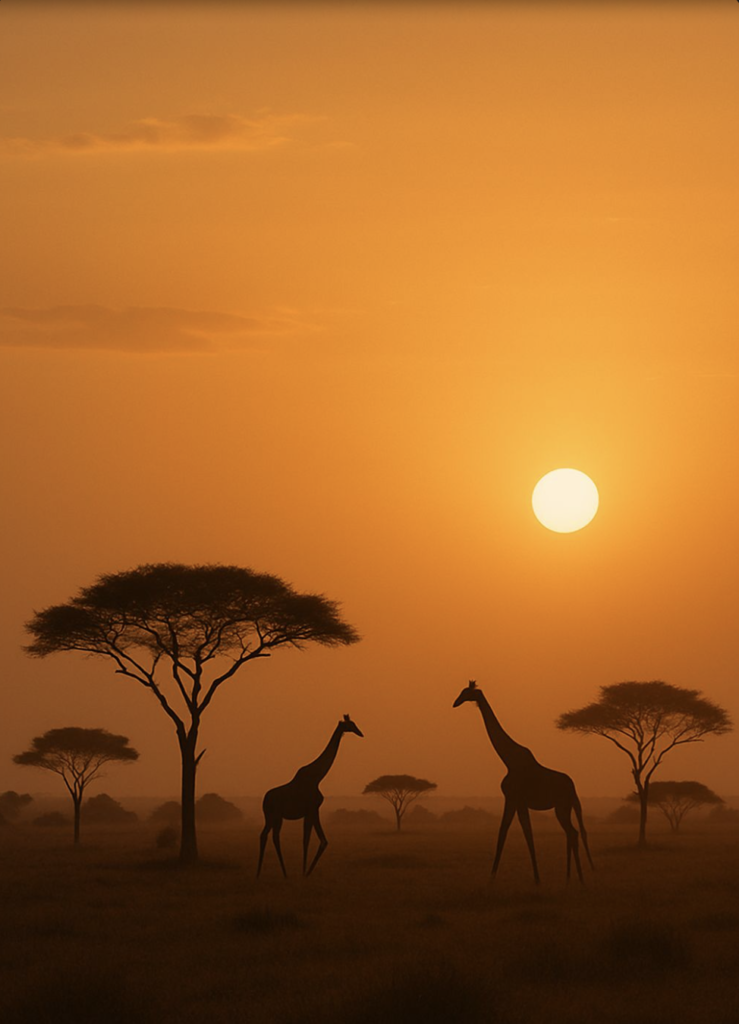
There is a certain magic in the sight of giraffes grazing in the golden light of an African savannah—those elegant silhouettes etched against a wide horizon, heads swaying among acacia branches, legs striding across grasslands. But the spectacle is not mere coincidence. Giraffes are exquisitely adapted to life in the savannah, and in many ways they have co-evolved with this landscape.
In this article, we’ll explore how and why giraffes do so well in the savannah environment: their anatomical adaptations, feeding strategies, social systems, movement and territory choice, predator-avoidance, reproduction, ecological roles, threats, and what the future may hold. By the end, you’ll see that giraffes are not just beautiful oddities—they are central actors in the savannah drama.
Here is the roadmap:
- The Savannah Setting: climate, vegetation, and ecology
- Giraffe diversity and taxonomy
- Anatomical and physiological adaptations
- Feeding ecology and nutrition
- Movement, home ranges, and seasonal patterns
- Social behavior, reproduction, and life history
- Predation, risk, and survival strategies
- Ecological roles and interactions
- Threats, conservation, and challenges
- Looking ahead: sustaining giraffes in a changing savannah
1. The Savannah Setting: Climate, Vegetation, and Ecology
To understand why giraffes thrive, we must first understand their backdrop: the African savannah.
Climate & Seasonality
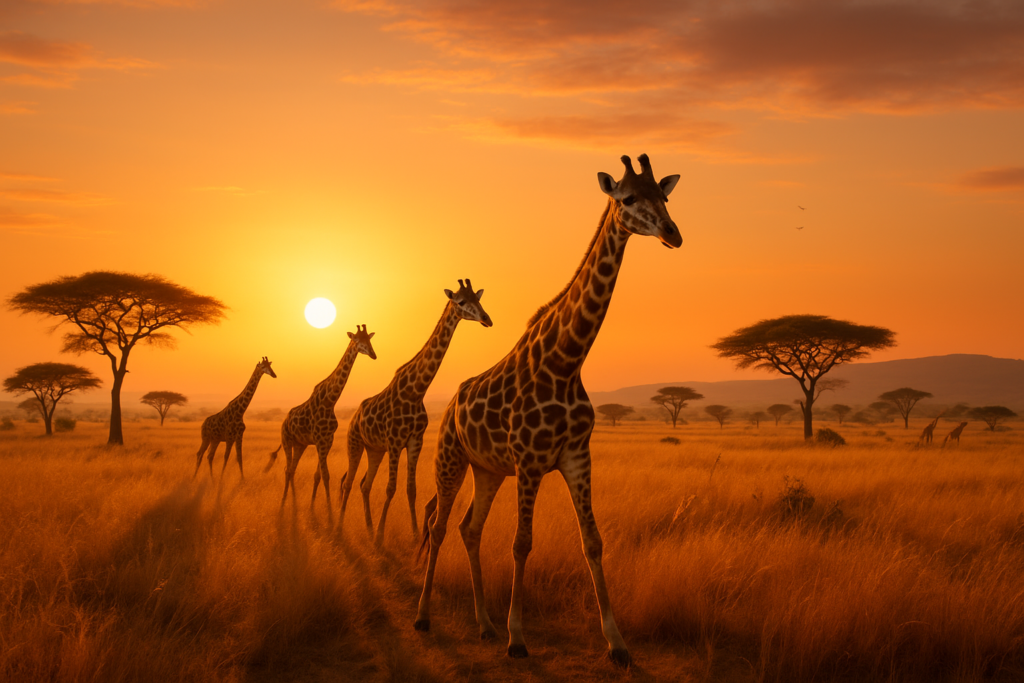
- The savannah is characterized by distinct wet and dry seasons. Rainfall is often concentrated in a few months, followed by a prolonged dry season.
- The dry season brings scarcity of surface water, increased stress on vegetation, and more competition among herbivores.
- Temperatures are generally high; in some regions, daily heat and radiant sun are intense.
Vegetation Structure
- The key feature of savannah is that it is grassland punctuated by trees and shrubs, not dense forest. Trees are relatively sparsely spaced.
- Common tree genera include Acacia, Commiphora, Terminalia, Combretum, and others. Giraffes often prefer trees of Acacia and related taxa.
- In the dry season, many trees lose leaves (deciduous), forcing browsers to seek evergreen or tough-leaved species.
- Fire is a natural part of many savannahs, shaping plant communities by suppressing woody encroachment and resetting successional dynamics.
Ecological Pressures & Opportunities
- The openness allows sunlight to reach grasses, but also means less shade and vulnerability to heat stress.
- Competition is high: many herbivores browse or graze at levels below canopy height.
- Water availability is patchy—animals must travel to seasonal water sources.
- Predators (lions, hyenas, leopards, wild dogs) are present, demanding defense, vigilance, or avoidance strategies.
In short, the savannah is a demanding environment. Giraffes succeed here because they are specially suited to exploit niches that many other herbivores cannot.
2. Giraffe Diversity and Taxonomy
Before delving deeper into giraffe biology, it’s useful to know who the giraffes are—because not all giraffes are the same.
Species & Subspecies
- For a long time, scientists considered giraffes as a single species (Giraffa camelopardalis) with multiple subspecies.
- More recent genetic and morphological work supports recognizing four distinct giraffe species:
1. Northern giraffe
2. Reticulated giraffe
3. Masai giraffe
4. Southern giraffe - Each species has its own subspecies or regional lineages (e.g., the Angolan giraffe is a subspecies of the Southern giraffe)
- The change in classification has important conservation implications: different giraffe species face different threats and occur in different regions.
Distribution & Habitat Preference
- Giraffes are mostly found south of the Sahara, across sub-Saharan Africa.
- Their habitat tends to be savannah and open woodland, especially where trees occur but are not dense.
- Some taxa tolerate more arid or semi-arid regions, or more wooded savannahs, depending on local resources.
Thus, while giraffes share a general ecological niche, the different taxa may vary in detailed adaptation to local savannah types.
3. Anatomical and Physiological Adaptations
Giraffes are among the most extreme animals in many respects. Their anatomy and physiology are tailored to overcome the challenges of the savannah.
Long Neck & Reach
- The giraffe’s signature feature: a long neck. This lets giraffes browse higher foliage—leaves and buds that other browsers cannot reach.
- The long neck gives giraffes access to a vertical food niche, reducing direct competition with lower browsers (e.g., impala, kudu).
- The neck also helps in vigilance: spotting predators early across open terrain.
- The skeleton includes elongated cervical vertebrae (though giraffes have the same number of neck vertebrae—seven—as most mammals, each is stretched and modified).
Limbs and Locomotion
- Their long, slim legs are suited to covering large distances across the savannah relatively efficiently.
- Gait mechanics: giraffes use a “pacing” gait at slower speeds (front and hind legs on one side move together) and transition to a gallop at higher speeds.
- Their stride is very long: fewer steps needed to cover ground, meaning energy efficiency when moving to water, forage, or ranges.
Circulatory and Cardiovascular Adaptations
- Because of the height difference between feet and head, giraffes have a large, powerful heart to pump blood up to the brain.
- The arterial system includes tight vascular control and specialized valves and vessels to regulate pressure, especially when the animal lowers or raises its head to drink.
- They possess rete mirabile and other countercurrent mechanisms in the neck to buffer pressure changes.
- Their blood pressure is among the highest of terrestrial mammals, to overcome gravity.
Digestive System and Nutritional Processing
- Giraffes are ruminants or more precisely foregut fermenters, with a multi-chambered stomach.
- Their digestive physiology allows them to extract nutrients from fibrous leaves—and to detoxify certain plant secondary compounds (e.g., tannins).
- They may consume large volumes of foliage relative to body size, especially during times of abundance.
Skin, Coat, and Thermoregulation
- Their spotted or blotched coat patterns serve as camouflage in dappled light of savannah woodlands, particularly for calves.
- The skin is thick in many areas, protecting from insect bites and abrasion.
- They can absorb solar heat on cool mornings; later, they may reduce exposure by seeking shade or adjusting posture.
- Their large surface area (legs, neck) helps in dissipating heat.
Other Adaptations
- Ossicones (the horn-like protrusions) are not just decorative—they may play roles in thermoregulation, display, and in male combat (“necking”).
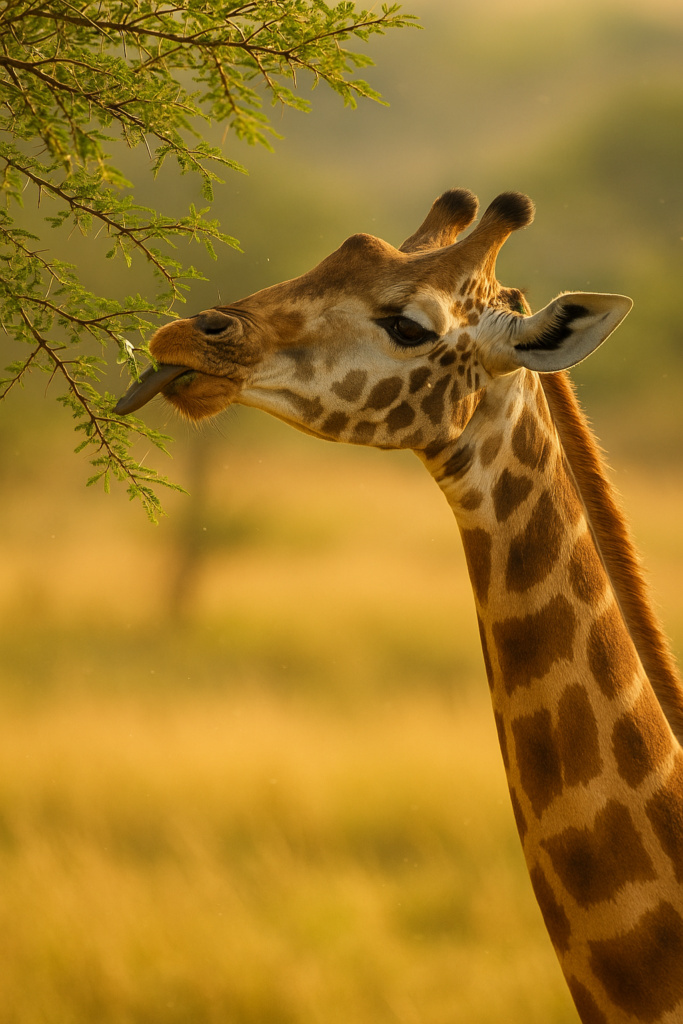
- Giraffes have a sensitive tongue and lips (often 45–50 cm long) that allow careful manipulation of foliage—pulling leaves off thorny branches, avoiding spines.
- The oral mucosa is tough/keratinized to resist abrasion and thorns.
Together, these adaptations equip giraffes to exploit the vertical, arboreal food niche, move across open ground, and contend with the physiological stresses of height and dryness.
4. Feeding Ecology and Nutrition
Perhaps more than any other factor, a giraffe’s success in the savannah depends on food acquisition: what they eat, when, where, and how efficiently.
Diet Composition
- Giraffes are browse specialists rather than grazers; they feed on leaves, shoots, buds, fruits, and flowers of woody plants.
- Their favorite food trees include Acacia (various species), Commiphora, Terminalia, Combretum, Mimosa, and others.
- In the wet season, they take advantage of abundant foliage; in the dry season, they shift to evergreen species, tougher leaves, or browse more widely.
- Some parts of woody plants that are nutrient-rich—flowers, young shoots, and pods—are preferred when available.
Feeding Strategy & Behavior
- Giraffes can reach heights of 4 to 6 meters (or more, depending on species and sex), meaning they browse above many competitors.
- They may move across multiple tree patches, often travelling to find food rather than staying localized.
- Giraffes may strip bark or gnaw branches when leaves are scarce, albeit less often.
- In certain areas, giraffe browsing influences the morphology of trees—trees may evolve to have canopies beyond giraffe reach or bolster thorniness.
- Research shows giraffe and elephant foraging can shape vegetation diversity and the structure of savannah landscapes, especially by preferring flat ground for foraging.
Nutritional Constraints and Tradeoffs
- Browse quality varies over seasons; dry-season leaves may be low in water and nutrients. Giraffes must balance intake, water needs, digestion, and movement costs.
- They may select patches of higher nutritional quality, even if further away.
- Water intake is supplemented by foliage water content, especially during the wet season—when leaves are succulent, they get much of their water that way, reducing the need to drink frequently.
- In very dry areas, giraffes may still visit water sources, but only irregularly.
Ecological Impact of Browsing
- Studies show that chronic giraffe browsing can reduce understorey grass biomass, soil moisture, and organic matter beneath heavily browsed trees, altering local micro-ecosystems.
- The trimming of trees by giraffes can reduce fire risk (less combustible undergrowth), influencing savannah fire regimes.
- As they browse, giraffes drop leaves, fruits, and seeds, aiding regeneration and spreading plant species.
Thus giraffes occupy a unique niche: high browsers that can persist even when lower browse is exhausted, although they always face tradeoffs of travel, nutritional balance, and plant defense.
5. Movement, Home Ranges, and Seasonal Patterns
Giraffes are not static. Their patterns of movement, range use, and seasonal shifts are vital to matching food and water resources across the savannah.
Home Range & Mobility
- Giraffe home ranges can be very large, varying by habitat quality, food distribution, and season.
- Some giraffe research, especially on Masai giraffes in Tanzania, tracks individuals over thousands of square kilometers, monitoring births, deaths, and mobility.
- Giraffe movements tend to be fission–fusion: groups form and dissolve, individuals roam, and sub-groups may coalesce temporarily.
- Because resources are patchy in savannahs, giraffes must travel to exploit scattered tree patches.
Seasonal Shifts
- During the wet season, foliage is abundant, and giraffes may spread out widely across the landscape.
- In the dry season, food and water become scarce. Giraffes concentrate closer to water sources or evergreen woody patches, sometimes migrating or shifting territory use.
- Some giraffes undertake nomadic foraging—not fixed migration but opportunistic movement to where resources persist.
- In some studies, giraffes prefer flat terrain for foraging, avoiding steep slopes when possible.
Movement Costs & Tradeoffs
- Traveling long distances costs energy—and in arid times, water stress can limit mobility.
- Giraffes may balance between staying near safer areas (from predation) and venturing to richer but riskier forage zones.
Their movement ecology enables them to persist in a dynamic environment, but it also imposes constraints, especially under habitat fragmentation or in regions with reduced connectivity.
6. Social Behavior, Reproduction, and Life History
Although giraffes might seem solitary, their social and reproductive behaviors are subtle, flexible, and shaped by savannah life.
Social Structure
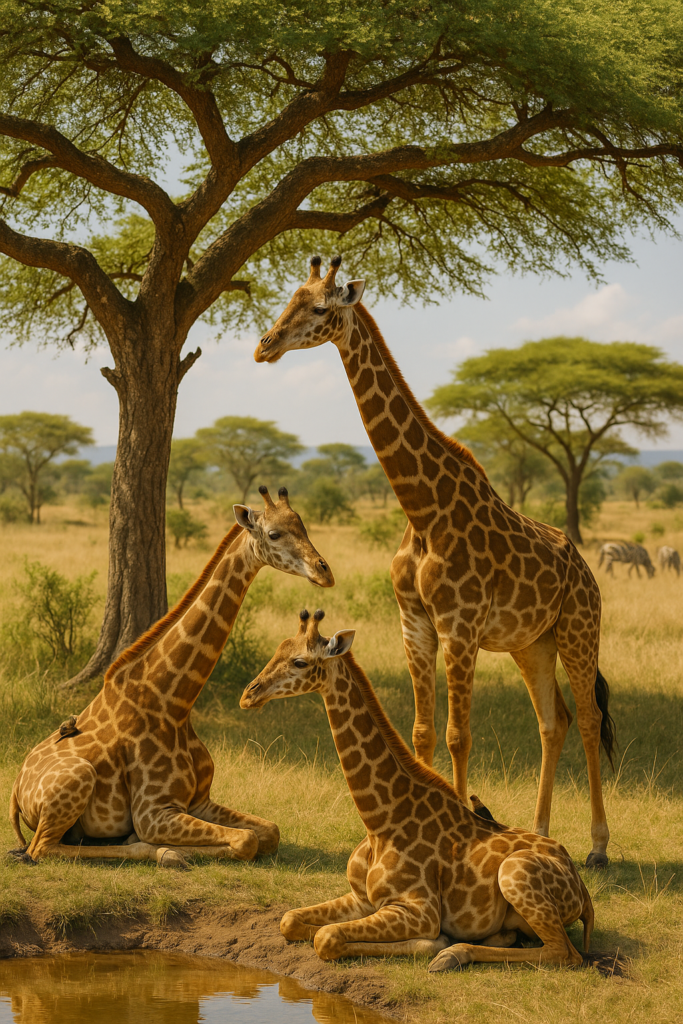
- Giraffe social organization is often described as open, fluid, and dynamic—individuals form temporary associations.
- Groups can vary in composition: females with calves, bachelor males, mixed aggregations.
- More recent observations indicate some long-term associations or “cliques”, especially among females or kin groups.
- Social ties may influence survival, reproductive success, and information sharing (e.g. about water sources).
- Because giraffes are spread out, social bonds can be looser than in more tightly grouped species.
Reproduction & Mating
- Giraffes are polygynous: males mate with multiple females over time.
- Males compete using necking, a behavior where they swing heads and necks, sometimes delivering heavy blows with ossicones. Victorious males gain greater access to females.
- Females exhibit a “flehmen response” to test male scent and fertility (licking urine, transferring it to receptors).
- Gestation lasts about 14–15 months.
- Females typically give birth to a single calf, though twins are rare.
- Calf survival is a major bottleneck: predation risk is high in the first months.
Growth, Longevity, and Mortality
- Giraffes grow relatively quickly in early life to reduce vulnerability.
- Adult survival is high, thanks to size, vigilance, and powerful defenses.
- A giraffe may live into its 20s or, in some instances, more than 30 years in optimal settings.
- Mortality sources: calves fall prey to lions, hyenas, leopards, wild dogs; adults may suffer from disease, drought, or poaching.
Tradeoffs & Constraints
- The low reproductive rate (one calf at a time) means population recovery is slow under pressure.
- Males incur costs in fighting and dispersal.
- Calves must be concealed and protected early—mothers sometimes hide calves in cover before rejoining the herd.
The social and reproductive strategies reflect a balance: giraffes must maintain flexibility to respond to resource distribution, while managing risk to offspring in a predator-laden environment.
7. Predation, Risk, and Survival Strategies
Being tall and conspicuous carries risks, especially in a landscape with powerful carnivores. But giraffes have evolved strategies to mitigate predation and survive.
Predators & Vulnerabilities
- Major predators: lions are the primary threat to adult giraffes (especially when they are isolated, infirm, or in groups).
- Calves: especially vulnerable to lions, hyenas, leopards, and wild dogs.
- Ambush risk: in denser bush edges, giraffes may be attacked.
- Other threats: drought, disease, parasites, human hunting.
Defense & Vigilance
- Their height gives excellent vantage to spot predators at distance across the savannah.
- Giraffes often associate with species like zebras or antelopes; mutual vigilance benefits all. Indeed, studies suggest zebras may rely on giraffes to detect predators and reduce their own vigilance.
- Their powerful kicks (especially from hind legs) can deliver lethal blows to predators.
- Adults seldom fall prey; much of the predation burden is on juveniles.
- Mothers may conceal calves in thickets or distant cover early on, returning periodically to nurse.
Risk Tradeoffs
- Venturing to better forage may increase exposure to predators.
- Standing in open areas is safer for detection, but browsing sometimes forces giraffes to enter riskier zones.
- Calves represent a vulnerability, so mothers may alter movement or feeding patterns to reduce risk.
Overall, giraffes mitigate risk via vigilance, physical defense, and behavioral strategies. Their size is itself a deterrent to many predators.
8. Ecological Roles and Interactions
Giraffes are not passive scenery—they are active participants and ecosystem engineers in the savannah.
Browsing and Vegetation Dynamics
- Giraffes prune trees, controlling bush encroachment and shaping canopy architecture.
- Their browsing patterns influence tree height, branch density, and species composition.
- In persistently browsed zones, trees may adapt with defenses (more thorns, tougher leaves, canopy position shifts).
- Giraffes, along with elephants, influence plant diversity, biomass distribution, and fire regimes.
- Because giraffes avoid very steep terrain when foraging, they may concentrate impact zones on gentler slopes, influencing spatial patchiness.
Seed Dispersal & Nutrient Cycling
- As giraffes eat fruit or consume leaves and excrete waste elsewhere, they act as seed dispersers.
- Their dung contributes nutrients to soil, aiding plant growth in areas they traverse.
- Their browsing also opens up light and space for lower strata plants or grasses.
Trophic Cascades
- The presence of large herbivores like giraffes suppresses smaller mammals (e.g. rodents) by competition or habitat alteration, indirectly influencing predator-prey dynamics. One study removed large mammals and found rodents increased, leading to more snakes and fleas.
- Browsing affects fuel loads and fire dynamics, which in turn affects community structure.
- Giraffes’ interactions with other herbivores (competition, facilitation) shape community composition.
Mutualisms & Interactions
- Birds such as oxpeckers ride giraffes, feeding on ticks and alerting the giraffe to danger.
- Giraffes may interact with mixed herbivore groups for mutual vigilance.
- In effect, giraffes are keystone in maintaining the balance of savannah ecosystems.
Thus, giraffes help structure their habitat, impact species composition, and influence ecological flows across the landscape.
9. Threats, Conservation, and Challenges
Despite their impressive adaptations, giraffes face increasing pressures in modern times. Their long-term survival depends on confronting these threats.
Major Threats
- Habitat Loss & Fragmentation
- Expansion of agriculture, human settlement, fencing, and infrastructure breaks up their movement corridors.
- Fragmented ranges limit access to seasonal forage and water.
- Poaching & Illegal Hunting
- Giraffes are hunted for meat, hides, or trophies. Poaching can disproportionately affect local populations.
- Population Isolation & Genetic Bottlenecks
- Small, isolated groups are more vulnerable to inbreeding, disease, and stochastic events.
- Competition with Livestock
- Livestock may compete for browse or reduce tree density near human settlements.
- Climate Change & Drought
- More frequent or severe droughts reduce forage, increase water stress, and may push giraffes into human areas, raising conflict.
- Disease & Parasites
- Giraffes host internal parasites, ticks, and skin disorders. In some areas, skin ailments affect a large percentage of giraffes (e.g., up to 79% in Ruaha National Park) though often not lethal.
- Neglected Conservation Status
- Giraffes have historically received less attention than elephants, lions, or rhinos. They have been under-studied and under-funded.
Conservation Efforts & Successes
- The Giraffe Conservation Foundation (GCF) leads continental strategies, research, and public awareness.
- Protected areas (national parks, reserves) provide safe habitat, albeit sometimes insufficiently sized or connected.
- Translocations and reintroductions are used in some regions; e.g., in 2023, fourteen Angolan giraffes were reintroduced to Iona National Park in Angola, where giraffes were thought extinct.
- Community-based conservation, wildlife corridors, and anti-poaching initiatives are vital.
- Genetic studies help define management units (species/subspecies), improving targeted conservation.
- Ecotourism provides funding and local motivation to preserve giraffe populations.
Conservation Challenges
- Securing adequate range—and maintaining connectivity—across national boundaries and human-dominated landscapes is difficult.
- Balancing human development (farming, infrastructure) with wildlife needs is contentious.
- Because giraffe reproduction is slow, declines can be hard to reverse, demanding long-term commitment.
- Climate unpredictability and extreme events (drought, collapse of forage) may test giraffe resilience.
In short, giraffe conservation is multi-faceted and urgent. The new taxonomy separating giraffes into multiple species underscores that each lineage may require distinct strategies.
10. Looking Ahead: Sustaining Giraffes in a Changing Savannah
What must be done to ensure that giraffes continue to grace Africa’s golden savannahs?
Strategic Priorities
- Landscape-level conservation planning: securing corridors and connectivity so giraffes can move seasonally.
- Integrating local communities: grazing management, compensation schemes, participatory conservation.
- Anti-poaching and monitoring: employing patrols, camera traps, community rangers, drones.
- Scientific research: continued tracking of populations, genetic studies, better knowledge of movement, disease, and climate responses.
- Veterinary support & health surveillance: monitoring disease outbreaks and parasites.
- Public outreach and education: raising awareness of giraffe’s ecological role and vulnerabilities.
Adaptation to Climate & Change
- Modeling future climate scenarios to predict giraffe habitat shifts.
- Ensuring protection of climate refugia—areas where vegetation and water persist under changing climates.
- Protecting water sources (springs, aquifers, wetlands) so giraffes can survive extended dry periods.
The Role of Humans
- Recognizing that giraffes are not zoo curiosities but essential components of savannah ecosystems.
- Promoting policies that balance land use with ecological integrity.
- Encouraging responsible ecotourism that benefits both communities and wildlife protection.
- Ensuring that giraffe conservation is prioritized alongside more charismatic species.
Conclusion
Giraffes are living testaments to evolutionary innovation—tall, graceful, and perfectly suited to the golden savannahs of Africa. Their long necks, powerful hearts, nimble tongues, and strategic behaviors allow them to reach food others can’t, travel across wide dry landscapes, and survive in a challenging environment. But success in the savannah is not given—it is earned through adaptation, balance, and navigation of risk.
Yet giraffes cannot thrive in isolation. Their continued existence depends on the preservation of vast savannah landscapes, connectivity across human-dominated territories, careful management, and respect for the delicate interplay between species, climate, and human pressures.
As you imagine a giraffe silhouetted against a sunset, munching on acacia leaves, consider this: the giraffe is not simply surviving — it is shaping the land, influencing community structure, and contributing to the wild song of the savannah. Protecting giraffes means protecting that song.