
Most people think they know the ocean. They picture coral reefs, dolphins, whales, tropical islands, and perhaps the occasional shark. Yet everything most humans associate with the ocean exists within a surprisingly thin layer near the surface. Beneath this familiar world lies an enormous hidden realm that remains one of the least explored environments on Earth. It is a place of perpetual twilight, strange glowing creatures, vast migrations, and biological processes so important that they help regulate the planet’s climate itself.
Scientists call this region the Mesopelagic Zone, although it is more commonly known as the Ocean Twilight Zone. Extending roughly from 200 to 1,000 meters below the surface, it sits between the bright sunlit waters above and the dark abyss below. Very little sunlight penetrates this region. The light that does reach it is dim and blue, creating an environment that resembles a permanent underwater sunset.
For decades, researchers knew surprisingly little about this hidden ecosystem. The challenges of studying it were immense. The depths were too deep for conventional scuba diving but too shallow for many deep-sea exploration systems. Organisms often avoided research equipment, and many species were incredibly fragile, making them difficult to collect and study.

As technology improved, however, scientists began discovering something extraordinary. The Twilight Zone is not a sparsely populated wilderness. It may actually contain more fish biomass than all of the world’s fisheries combined.
This revelation shocked marine scientists. For years, estimates of life in the Twilight Zone dramatically underestimated its true abundance. Advanced sonar systems revealed enormous layers of animals stretching across oceans worldwide. These layers were so dense that early sonar operators sometimes mistook them for the seafloor itself.
The discovery transformed scientific understanding of ocean ecosystems.
One of the most fascinating aspects of the Twilight Zone is the daily migration that occurs there. Every evening, billions of fish, squid, crustaceans, and other organisms rise toward the surface to feed under the cover of darkness. As dawn approaches, they descend once again into deeper waters.
This migration occurs every single day.
It is considered the largest animal migration on Earth.
Unlike the dramatic migrations of wildebeest across Africa or whales crossing oceans, this migration happens largely unseen. Trillions of individual organisms move vertically through the water column each night, transporting nutrients and carbon between different ocean layers.

Scientists often describe this phenomenon as the “biological pump.”
As organisms feed near the surface and later return to deeper waters, they effectively move carbon away from the atmosphere. This process helps lock carbon into deeper ocean systems, influencing global climate regulation.
Without the Twilight Zone, Earth’s climate might look very different.

The importance of this hidden ecosystem extends far beyond marine biology. Increasingly, researchers believe that understanding the Twilight Zone may be essential for understanding how the entire planet functions.
One reason the Twilight Zone remained mysterious for so long is because many of its inhabitants appear almost alien. Evolution within low-light environments has produced extraordinary adaptations rarely seen elsewhere.
Bioluminescence is perhaps the most famous.
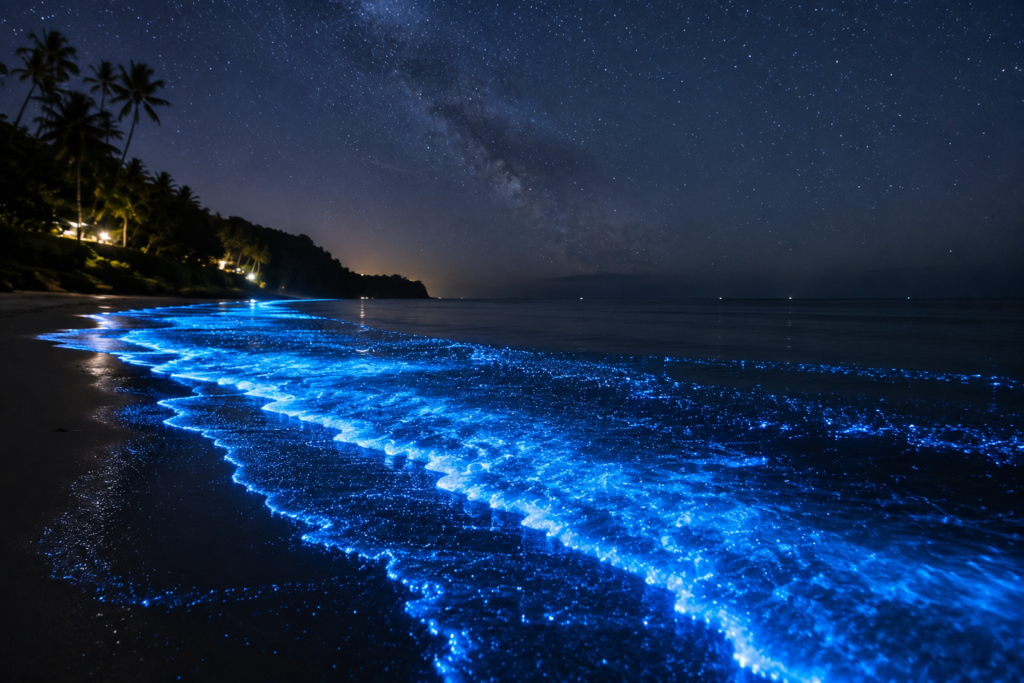
Many Twilight Zone animals generate their own light through chemical reactions occurring inside specialised organs. Tiny fish, squid, shrimp, and jellyfish glow blue, green, or occasionally red within the darkness. Some use light to attract prey. Others use it to find mates. Many use it as camouflage.
Counterillumination is one particularly remarkable adaptation. Some fish produce light on their undersides that matches the faint sunlight filtering down from above. Predators looking upward see only a silhouette against the light. By generating their own glow, these fish effectively erase their shadows and become nearly invisible.
Nature repeatedly demonstrates astonishing ingenuity.
The deeper scientists explore the Twilight Zone, the more unusual its inhabitants become. Dragonfish possess enormous teeth and transparent bodies. Hatchetfish appear almost metallic. Lanternfish use intricate patterns of glowing organs that may function like species-specific identification systems.
Many creatures look like something from science fiction.
Despite their strange appearance, these organisms play critical roles within ocean food webs. Many larger predators depend upon Twilight Zone species as a major food source. Tuna, swordfish, dolphins, seals, whales, and numerous seabirds ultimately rely upon the productivity of these hidden ecosystems.

The Twilight Zone helps support life throughout the ocean.
This interconnectedness highlights one of the most important lessons in ecology: visible ecosystems often depend upon hidden processes operating out of sight. The ocean surface may appear calm and empty, but beneath it lies a dynamic world supporting much of marine biodiversity.
The more scientists study the Twilight Zone, the more questions emerge.
How much life actually exists there?
How important is it for climate regulation?
What species remain undiscovered?

What would happen if humans began exploiting its resources at industrial scales?
These questions have become increasingly urgent because commercial interest in the Twilight Zone is growing. Some fishing industries view mesopelagic fish as a potentially enormous untapped resource. Given the estimated biomass present, the economic temptation is obvious.
Yet many scientists urge caution.
The Twilight Zone remains poorly understood. Removing large quantities of biomass from these ecosystems could have consequences that ripple throughout ocean food webs. Species that appear abundant may reproduce slowly or occupy crucial ecological roles not immediately apparent.
History shows that exploiting ecosystems before fully understanding them often leads to unintended consequences.

This concern mirrors broader conservation challenges facing marine environments worldwide. The ocean remains humanity’s largest life-support system, yet vast regions remain poorly explored. Scientists estimate that a significant percentage of marine species have not yet been described by science.
In many ways, humanity knows more about the surface of Mars than the depths of its own oceans.
This mystery helps explain why ocean exploration continues capturing public imagination. Every expedition has the potential to reveal species, behaviours, and ecosystems never previously documented.
For people fascinated by marine life, a book like National Geographic Ocean: A Global Odyssey provides an excellent introduction to the incredible diversity hidden beneath the waves. Understanding the ocean often begins with appreciating how little we truly know.

Technology has become one of the most powerful tools driving modern ocean discoveries. Advanced remotely operated vehicles, autonomous underwater drones, and sophisticated sonar systems now allow scientists to investigate environments that were once almost completely inaccessible.
Each technological breakthrough reveals new layers of complexity.
Researchers frequently encounter organisms exhibiting behaviours no one anticipated. Some species undertake migrations spanning hundreds of meters each day. Others possess unique sensory systems adapted to near-total darkness. Entire ecological communities operate according to rules that differ dramatically from those observed in shallow waters.
Photography and videography have played a major role in bringing these discoveries to public attention. Stunning images of glowing jellyfish, transparent fish, and deep-sea predators have transformed public perception of the ocean.

A camera such as the GoPro HERO13 Black has become popular among ocean enthusiasts because it allows people to document marine environments ranging from coral reefs to open-water adventures. While it cannot reach Twilight Zone depths, it helps foster appreciation for marine ecosystems that ultimately connect to these deeper worlds.
One of the most remarkable findings emerging from Twilight Zone research involves carbon cycling. Scientists increasingly recognise that biological processes within this region influence Earth’s climate on a planetary scale.
When organisms migrate between surface waters and deeper layers, they transport organic matter downward. This movement helps remove carbon from the atmosphere and store it within ocean systems.
The scale of this process is immense.
Every night, billions of animals participate in an invisible planetary service that helps regulate atmospheric carbon levels. Few people are aware it exists, yet it may influence climate stability worldwide.
This discovery highlights an important reality: some of Earth’s most important ecosystems are also among its least visible.
The Twilight Zone demonstrates that environmental importance does not always correlate with public awareness. Hidden ecosystems can shape planetary processes just as profoundly as forests, wetlands, and coral reefs.
For nature lovers inspired by ocean exploration, equipment like the Celestron Nature DX 8×42 Binoculars often enhances coastal wildlife observation. Watching seabirds, dolphins, and migrating whales provides a glimpse into food webs ultimately connected to the deeper ocean below.
The ocean’s mysteries also inspire curiosity among younger generations. Educational tools such as the LEGO Technic Deep-Sea Explorer Submarine encourage interest in marine science, engineering, and exploration. Many future oceanographers begin with simple fascination about what exists beneath the waves.
Perhaps the most profound lesson of the Twilight Zone is how much remains unknown.
Despite centuries of exploration, Earth still contains environments capable of surprising scientists. New species are discovered regularly. New ecological processes continue emerging. Technologies reveal hidden dimensions of ecosystems once thought understood.
The ocean remains a frontier.
Every major discovery within the Twilight Zone reminds humanity that exploration is far from complete. Vast regions of the planet continue operating beyond ordinary human experience, shaping climate, biodiversity, and ecological stability without attracting widespread attention.
Even simple activities such as snorkeling can spark deeper appreciation for these hidden systems. Products like the Cressi Palau Short Fin Snorkeling Set help people connect directly with marine environments, fostering curiosity about the larger ocean ecosystem beyond the visible shallows.
Ultimately, the Ocean Twilight Zone is fascinating because it challenges assumptions. Most people imagine the most important ecosystems as places they can see—forests, reefs, rivers, and grasslands. Yet one of Earth’s largest and most influential ecosystems exists largely out of sight.
It is a world of perpetual twilight, glowing creatures, endless migrations, and hidden biological machinery quietly helping regulate life on Earth.
And despite decades of research, scientists believe they have only begun to uncover its secrets.